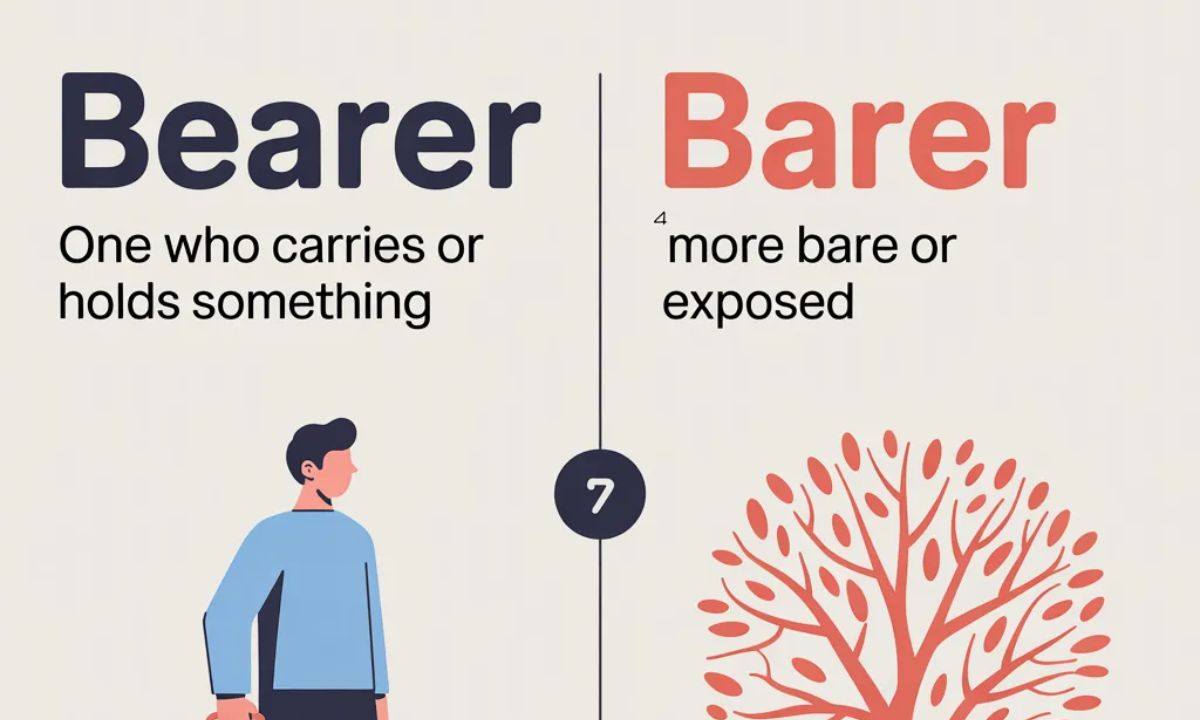
English contains many words that sound similar but have completely different meanings, and “bearer” and “barer” are a common source of confusion for learners. While they differ by only one letter, their usage, grammar role, and meaning are entirely unrelated. “Bearer” refers to a person who carries or holds something, often used in formal, legal, or financial contexts.
On the other hand, “barer” is the comparative form of “bare,” meaning something that is more exposed or less covered. Understanding the distinction between these two words is important for clear writing, accurate communication, and avoiding common spelling mistakes. This article breaks down both terms in detail with examples, comparisons, and practical usage tips.
What Does Bearer Mean?
The word “bearer” refers to a person who carries, holds, or brings something. It is commonly used in formal, financial, and legal contexts.
Meaning of Bearer:
A bearer is someone who carries or is responsible for delivering something.
Common Uses:
- A person carrying a message
- The holder of a document or ticket
- Someone who possesses a financial instrument
Examples:
- The bearer of this letter must present it at the office.
- He is the bearer of good news.
- The cheque is payable to the bearer.
What Does Barer Mean?
The word “barer” comes from the adjective “bare”, which means exposed, uncovered, or minimal. “Barer” is the comparative form, meaning more bare or less covered than something else.
Meaning of Barer:
Something that is more exposed or less covered compared to another.
Common Uses:
- Physical appearance (bare skin, bare land)
- Minimal conditions or lack of covering
Examples:
- After the storm, the tree looked barer than before.
- The room felt even barer after removing the furniture.
- His garden is barer than his neighbor’s.
Key Differences Between Bearer and Barer
| Feature | Bearer | Barer |
| Word Type | Noun | Adjective (comparative) |
| Meaning | A person who carries or holds something | More bare or uncovered |
| Usage | Legal, financial, formal contexts | Descriptive comparison |
| Root Word | Bear | Bare |
| Example | Bearer of a message | Barer landscape |
Bearer in Sentences
Here are common real-life examples using bearer:
- The bearer of this ticket will be allowed entry.
- She acted as the bearer of bad news.
- The cheque is valid only for the bearer.
- He is the bearer of the company’s official documents.
Barer in Sentences
Here are examples using barer:
- The hill became barer after deforestation.
- His explanation made the truth barer than before.
- The desert looks barer in summer.
- After painting, the wall looked even barer in some spots.
Common Mistakes When Using Bearer or Barer
1. Using “Barer” When “Bearer” is Correct
❌ He is the barer of good news.
✔ He is the bearer of good news.
2. Misusing “Bearer” in Informal Contexts
❌ The room looks bearer after cleaning.
✔ The room looks barer after cleaning.
3. Spelling Mistakes
Many learners confuse spelling:
- Bearer ❌ spelled as “barer”
- Barer ❌ spelled as “bearer”
Tip:
- Bearer = carry (bear + er)
- Barer = bare (more bare)
Tips to Overcome the Difference
- Remember: Bearer = carries something
- Remember: Barer = more empty or exposed
- Link “bearer” with responsibility or possession
- Link “barer” with appearance or condition
- Practice with sentences daily
Scenario Examples Highlighting Differences
Scenario 1: Office Use
- The bearer of the document must sign it.
Scenario 2: Home Description
- After renovation, the room looks barer.
Scenario 3: Legal Context
- The bearer of the cheque can withdraw money.
Scenario 4: Nature Description
- The forest became barer after logging.
Everyday Usage Examples
In everyday English, “bearer” and “barer” appear in very different contexts. One is commonly used in formal or official situations, while the other is used in descriptive comparisons. Understanding how they function in real life helps you avoid confusion and use them naturally.
Bearer in Sentences
The word “bearer” is used when someone is carrying, holding, or responsible for something important like a message, document, or object.
Examples:
- The bearer of this letter must present it at the reception.
- She was the bearer of good news for the entire team.
- The cheque is payable to the bearer only.
- He acted as the bearer of important information.
- The bearer of the invitation will be allowed entry into the event.
Barer in Sentences
The word “barer” is used to describe something that is more exposed, empty, or uncovered compared to something else.
Examples:
- After the storm, the garden looked even barer than before.
- The walls became barer after removing all the decorations.
- His explanation made the truth barer to everyone.
- The desert appears barer during the summer months.
- The tree looked barer after losing all its leaves.
Bearer of Bad News or Barer?
The correct phrase is: ✔ Bearer of bad news
Correct Usage:
- He was the bearer of bad news about the project delay.
- She became the bearer of bad news when she informed them about the cancellation.
Incorrect Usage:
- ❌ He was the barer of bad news.
Why?
- Bearer = someone who carries or delivers something (like news, messages, or documents).
- Barer = has nothing to do with carrying; it only describes something that is more exposed or less covered.
👉 So, whenever you are talking about delivering news (good or bad), always use bearer, not barer.
Everyday Usage Examples
- Bearer: passport bearer, cheque bearer, message bearer
- Barer: barer land, barer room, barer tree branches
Bearer vs Barer Table Summary
| Aspect | Bearer | Barer |
| Meaning | Carrier or holder | More bare or exposed |
| Grammar | Noun | Adjective (comparative) |
| Context | Formal/legal/financial | Descriptive/visual |
| Confusion Risk | High in spelling | High in usage |
| Example | Bearer of truth | Barer landscape |
Frequently Asked Questions
1. Is “barer” a real word?
Yes, but it is less common. It is the comparative form of “bare.”
2. What is the main difference between bearer and barer?
“Bearer” means someone who carries something, while “barer” means more uncovered.
3. Can I use “barer” in formal writing?
Yes, but mostly in descriptive or literary contexts.
4. Why do people confuse these words?
Because they sound similar and differ by only one letter.
5. Is “bearer” used in legal terms?
Yes, especially in documents like “bearer cheque” or “bearer bonds.”
Conclusion
To sum up, although “bearer” and “barer” look and sound similar, they serve very different purposes in English. Bearer is used to describe a person who carries, possesses, or delivers something, especially in official or financial contexts. In contrast, barer describes something that is more bare, exposed, or uncovered compared to another.
Mixing these words can lead to confusion and incorrect sentences, but remembering their root meanings—bear (carry) and bare (exposed)—makes it easy to use them correctly. With regular practice and attention to context, you can confidently distinguish between bearer and barer in both writing and speech.