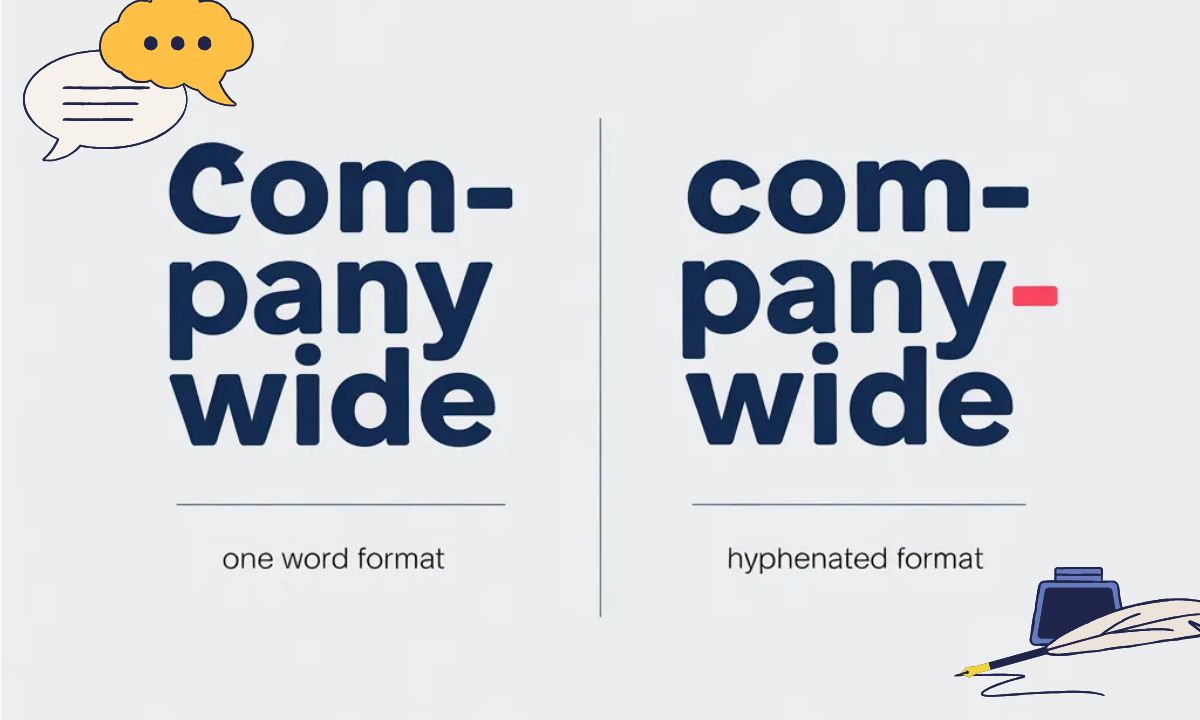
If you’ve ever paused while writing “companywide” or “company-wide,” you’re not alone. This common grammar question often confuses professionals, students, and even experienced writers. Should you use a hyphen, or is one word more correct? The answer depends on grammar rules, sentence structure, and style guide preferences. Understanding the difference is essential for clear and professional communication—especially in business writing.
In this guide, you’ll learn exactly when to use company-wide with a hyphen and when companywide as one word works better. We’ll break down grammar rules, provide real-world examples, and explain what major style guides recommend. By the end, you’ll confidently choose the correct form every time.
Hyphenation Rule – Company-Wide vs. Companywide
The difference between company-wide and companywide comes down to hyphenation rules in English.
- Company-wide (hyphenated) → Used as a compound adjective before a noun
- Companywide (closed form) → Used as an adverb or after the noun
Quick Rule:
👉 Use company-wide before a noun
👉 Use companywide after a noun (or when no noun follows)
When to Use the Hyphen in Company-Wide
You should use company-wide with a hyphen when it appears before a noun and acts as a compound modifier.
Why the hyphen matters:
The hyphen connects “company” and “wide” so readers understand they work together to describe something.
Examples:
- The company-wide policy improved productivity.
- We announced a company-wide meeting.
- A company-wide strategy was implemented last year.
Explanation:
Without the hyphen, the sentence may feel unclear or awkward. The hyphen ensures clarity and readability.
Tip:
If you can place the phrase directly before a noun, use the hyphen.
The Case for Writing Companywide as One Word
The closed form companywide is also correct—but used differently.
When to use “companywide”:
- When it comes after the noun
- When it functions as an adverb
Examples:
- The policy was applied companywide.
- Changes were implemented companywide.
- The company adopted the rule companywide.
Why this works:
Here, “companywide” describes how something happened, not what kind of thing it is.
Simple trick:
If removing the word doesn’t break the sentence structure, you likely need companywide (one word).
What Do Major Style Guides Say About Company-Wide?
Different style guides have slightly different preferences, but they follow the same general rule.
1. AP Style (Associated Press)
- Prefers hyphenated compound modifiers
- Recommends: company-wide before nouns
2. Chicago Manual of Style
- Accepts both forms
- Suggests consistency within writing
3. Merriam-Webster Dictionary
- Lists companywide as a valid word
- Recognizes company-wide as a common variant
Key Takeaway:
✔ Both forms are correct
✔ Hyphenated form is more common in formal/business writing
✔ Consistency is crucial
How to Use Company-Wide Correctly in Sentences
Let’s look at correct usage in different sentence structures.
Before a noun (use hyphen):
- We launched a company-wide initiative.
- The company-wide announcement surprised everyone.
After a noun (no hyphen):
- The initiative was implemented companywide.
- The announcement reached employees companywide.
In both positions:
- A company-wide update was shared companywide.
Business Writing Examples
In professional writing, choosing the correct form improves clarity and credibility.
Emails:
- We are introducing a company-wide policy starting Monday.
Reports:
- The new system will be implemented companywide by Q4.
Presentations:
- Our company-wide goals focus on growth and innovation.
HR Communication:
- Training will be mandatory companywide.
Company-Wide vs Companywide Usage (Comparison Table)
| Feature | Company-Wide (Hyphen) | Companywide (One Word) |
| Grammar Role | Adjective | Adverb |
| Position | Before a noun | After a noun |
| Example | Company-wide policy | Applied companywide |
| Formal Writing | Preferred | Acceptable |
| Clarity | More precise | More concise |
Common Mistakes
Even experienced writers make errors when using companywide vs company-wide.
1. Using no hyphen before a noun
❌ The company wide policy was updated.
✔ The company-wide policy was updated.
2. Using hyphen after a noun unnecessarily
❌ The policy was applied company-wide.
✔ The policy was applied companywide.
3. Inconsistent usage
❌ Company-wide meeting… later company-wide used incorrectly
✔ Stay consistent with grammar rules
Incorrect Usage
Here are some examples to avoid:
- ❌ We held a companywide meeting.
✔ We held a company-wide meeting. - ❌ The rule applies company-wide across all departments.
✔ The rule applies companywide across all departments. - ❌ A company wide decision was made.
✔ A company-wide decision was made.
People Also Ask
Is companywide one word or two?
“Companywide” is one word when used as an adverb. “Company-wide” is hyphenated when used before a noun.
Which is more correct: companywide or company-wide?
Both are correct. The choice depends on sentence structure.
Should company-wide always be hyphenated?
No. Only hyphenate when it appears before a noun.
Is companywide formal?
Yes, but “company-wide” is more common in formal business writing.
FAQs
What is the main difference between companywide and company-wide?
The main difference is grammar. Company-wide is an adjective, while companywide is an adverb.
Can I use companywide in professional writing?
Yes, but ensure it’s used in the correct position within the sentence.
Which form is more common in business communication?
“Company-wide” is more commonly used in formal documents and reports.
Is “company wide” without a hyphen correct?
No, it is considered incorrect in most cases.
How do I remember the rule easily?
Use company-wide before nouns and companywide after nouns.
Conclusion
Understanding the difference between companywide and company-wide is simple once you know the rule. Use company-wide when describing a noun and companywide when describing an action. While both forms are correct, the hyphenated version is more common in formal writing and helps improve clarity.
To write confidently, focus on sentence structure and stay consistent throughout your content. Mastering this small grammar detail can make a big difference in how professional and polished your writing appears.