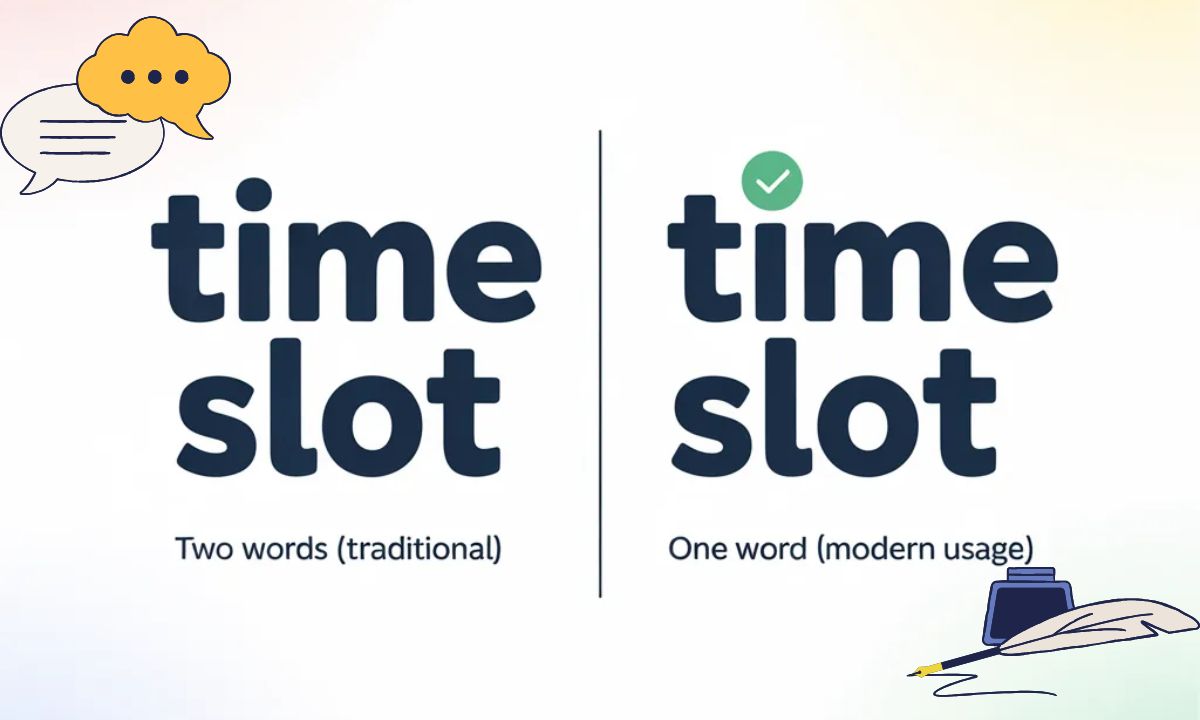
If you’ve ever wondered whether to write “time slot” or “timeslot,” you’re not alone. This common confusion appears in emails, scheduling apps, business communication, and even job postings. Choosing the correct form matters because it affects clarity, professionalism, and even SEO performance. In most cases, “time slot” (two words) is the standard and widely accepted form in modern English. However, “timeslot” (one word) occasionally appears in informal or technical contexts.
In this complete guide, you’ll learn the exact difference between time slot vs timeslot, when to use each form, and how to avoid common mistakes. We’ll also explore real-life examples, synonyms, and best practices so you can use the correct version confidently in any situation.
What Does “Time Slot” Mean?
A time slot is a specific, scheduled period allocated for an activity, event, or task.
Simple Definition:
A time slot is a fixed block of time reserved for something.
Examples:
- Please select a time slot for your appointment.
- The meeting is scheduled in the 3 PM time slot.
- Each speaker gets a 10-minute time slot.
Key Characteristics:
- Clearly defined start and end time
- Used for scheduling and planning
- Common in business, healthcare, and events
What Does “Timeslot” Mean?
Timeslot is simply a variant spelling of “time slot.”
Simple Definition:
A timeslot means the same thing as a time slot, but it is written as one word.
Examples:
- Choose your preferred timeslot online.
- All timeslots for today are fully booked.
Important Note:
Although “timeslot” is understandable, it is less commonly used and often considered informal or stylistic.
What’s the Difference Between Time Slot and Timeslot?
Quick Answer (Featured Snippet Style)
- Time slot (two words) → Correct and standard form
- Timeslot (one word) → Informal or less common variant
Detailed Comparison:
| Feature | Time Slot ✅ | Timeslot ⚠️ |
| Spelling Standard | Yes | No |
| Dictionary Usage | Widely accepted | Limited |
| Professional Writing | Recommended | Not preferred |
| Informal Use | Acceptable | Acceptable |
| SEO Performance | Better | Lower |
👉 Conclusion: Always use “time slot” in professional, academic, and SEO writing.
The Standard Two-Word Form
The correct and widely accepted version is:
👉 Time Slot
Why It’s Standard:
- It follows traditional English spacing rules
- Most dictionaries and style guides use it
- It improves readability
- It is preferred in professional communication
Where You’ll See It:
- Booking systems
- Emails
- Business reports
- Academic writing
Example Sentences:
- Please book a time slot for your interview.
- We have limited time slots available.
When One Word Appears
The one-word version “timeslot” appears in certain situations.
Common Contexts:
- Informal writing
- UI/UX design (apps and websites)
- Technical documentation
- Space-saving text
Example:
- Select your preferred timeslot from the list.
Why It Exists:
- Language evolves over time
- Compound words often merge (e.g., “email”)
- Digital platforms favor shorter forms
Should You Use It?
✔ Use sparingly
❌ Avoid in formal writing
How to Use Time Slot Correctly in Different Contexts
Using time slot correctly depends on context. Let’s break it down.
1. Business Communication
Use time slot in emails and meetings.
Examples:
- Kindly confirm your preferred time slot.
- The presentation will be in the morning time slot.
✔ Always use two words for professionalism
2. Healthcare & Appointments
Very common in scheduling systems.
Examples:
- Book your doctor’s time slot online.
- Morning time slots are fully booked.
3. Education
Used in timetables and exams.
Examples:
- Exams are divided into different time slots.
- Choose a lab time slot.
4. Events & Conferences
Important for planning sessions.
Examples:
- Each speaker gets a 20-minute time slot.
- Workshops are assigned specific time slots.
5. Digital Platforms
Both forms may appear, but time slot is still better.
Examples:
- Select a time slot for delivery.
- Available time slots are shown below.
Time Slot Usage Across Contexts
Here’s how time slot adapts across industries:
| Context | Usage Example |
| Business | Meeting time slot |
| Healthcare | Appointment time slot |
| Education | Class time slot |
| Events | Speaking time slot |
| Delivery Apps | Delivery time slot |
👉 Notice: “time slot” works everywhere—this is why it’s preferred.
Time Slot Synonyms and Related Terms
Sometimes, you may want alternatives for variety or SEO.
Common Synonyms:
- Time period
- Time frame
- Schedule block
- Appointment window
- Booking slot
- Time window
- Session
Example Usage:
- Choose a suitable time window.
- Select an appointment slot.
👉 Tip: Use synonyms naturally, but keep time slot as your main keyword.
Common Mistakes to Avoid
❌ 1. Using “timeslot” in formal writing
Always use time slot instead.
❌ 2. Mixing both forms
Stay consistent throughout your content.
❌ 3. Overusing the keyword
Maintain natural keyword density (1–1.5%).
❌ 4. Incorrect plural form
✔ Correct: time slots
❌ Incorrect: timeslot’s
SEO Tips: Time Slot vs Timeslot
If you’re writing for SEO, this matters a lot.
Best Practices:
- Use time slot as your primary keyword
- Include variations naturally
- Use it in:
- Title
- Headings
- First 100 words
- Meta description
Why “Time Slot” Wins:
- Higher search volume
- Better readability
- Matches user intent
Real-Life Examples
Example 1: Email
“Please confirm your preferred time slot for the meeting.”
Example 2: Booking Website
“Select an available time slot for delivery.”
Example 3: Event Planning
“Each speaker has a fixed time slot.”
People Also Ask (PAA)
Is “time slot” one word or two?
Time slot is two words and is the correct standard form.
Can I write “timeslot”?
Yes, but it’s informal and less preferred.
Which is better for SEO: time slot or timeslot?
Time slot performs better for SEO.
Is “timeslot” incorrect?
Not completely, but it’s not standard.
Voice Search Optimization Section
Here are natural, voice-friendly answers:
- “The correct spelling is time slot, written as two words.”
- “A time slot is a specific period reserved for an activity.”
- “Timeslot is less common and mostly informal.”
Quick Recap
- ✅ Time slot = correct and standard
- ⚠️ Timeslot = informal variant
- 📈 Use “time slot” for SEO and professional writing
- 🧠 Both mean the same thing
Final Verdict
When choosing between time slot or timeslot, the answer is clear:
👉 Always use “time slot” (two words) for accuracy, clarity, and professionalism.
While “timeslot” may appear occasionally, it is not the preferred form in modern English—especially in business, academic, or SEO writing.
FAQ’s
What is the correct spelling: time slot or timeslot?
The correct spelling is time slot (two words).
Why do some people write timeslot?
Because language evolves and compound words sometimes merge over time.
Is timeslot acceptable in formal writing?
No, it is better to use time slot.
Are both words interchangeable?
Yes, but time slot is preferred.
What is the plural of time slot?
The plural is time slots.
Conclusion
Understanding the difference between time slot and timeslot helps you communicate more clearly and professionally. While both forms carry the same meaning, only “time slot” meets standard grammar rules and SEO best practices. Whether you’re writing emails, booking systems, or blog posts, using the correct form improves credibility and readability.
So next time you schedule a meeting or publish content, remember this simple rule:
👉 Stick with time slot—it’s the right choice every time.