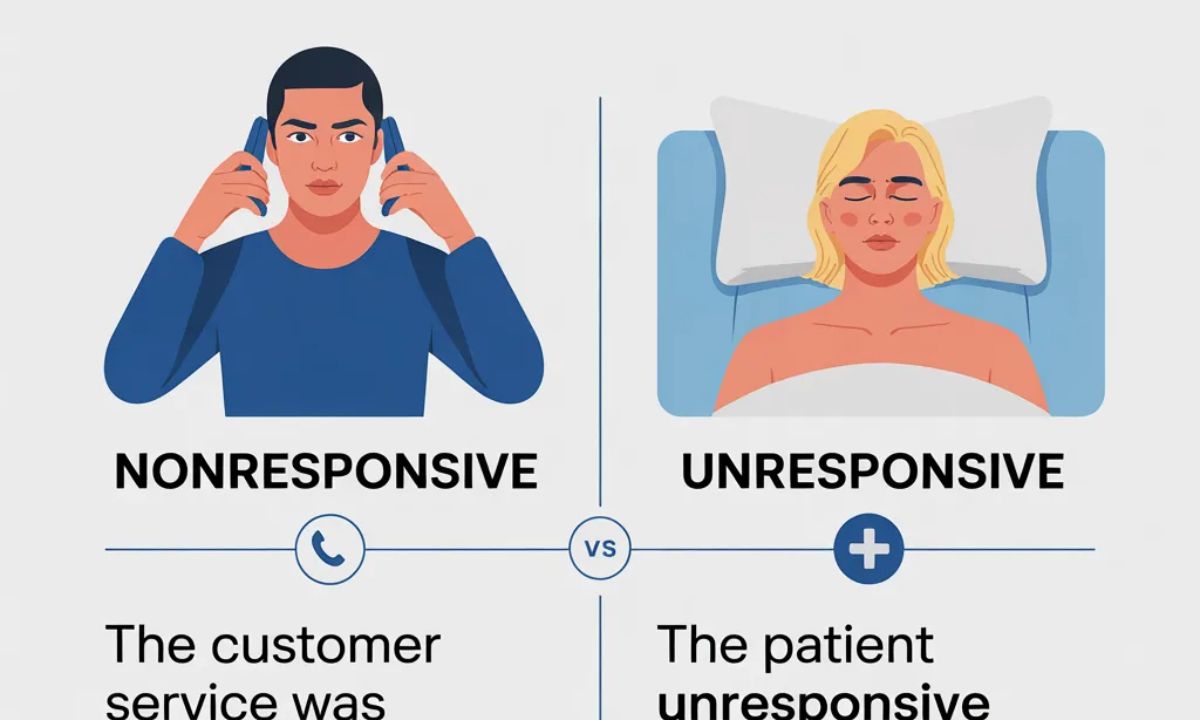
Many people get confused when they see the words nonresponsive vs unresponsive in writing, medical reports, workplace communication, or even casual conversation. At first glance, both words look almost the same and even seem interchangeable. However, in English usage, they carry subtle but important differences in tone, context, and application.
In simple terms:
- Unresponsive is commonly used in medical, emotional, and physical contexts.
- Nonresponsive is often used in technical, formal, or system-based contexts.
Understanding the difference between nonresponsive vs unresponsive helps improve clarity in communication, especially in professional writing, healthcare, IT systems, and education.
This detailed guide breaks everything down in a simple, human-friendly way.
Origin of Words: Nonresponsive vs Unresponsive
To understand nonresponsive vs unresponsive, it helps to look at their linguistic structure.
Nonresponsive
- Prefix: non- meaning “not”
- Root: responsive
- Meaning: Not showing a response (often in a technical or formal sense)
The word “nonresponsive” is mostly used in structured or professional environments like:
- Technology systems
- Surveys
- Data responses
- Technical reports
Unresponsive
- Prefix: un- meaning “not”
- Root: responsive
- Meaning: Not reacting or replying, especially in human, emotional, or medical situations
The word “unresponsive” is more commonly used in everyday English, healthcare, and emotional contexts.
Nonresponsive Meaning
Nonresponsive means something that does not respond to input, requests, or stimuli, especially in structured systems.
Simple Definition:
Nonresponsive refers to systems, tools, or processes that fail to respond or react as expected.
Key Characteristics:
- Used in technical or formal contexts
- Common in IT, business, and data systems
- Less emotional or human-focused
Example:
- The website became nonresponsive during high traffic.
- The survey system is nonresponsive to user input.
Unresponsive Meaning
Unresponsive means not reacting, replying, or responding—often used for people, emotions, or medical conditions.
Simple Definition:
Unresponsive refers to a person or system that does not react to stimuli, communication, or commands.
Key Characteristics:
- Common in medical language
- Used for emotional reactions
- Used for both humans and systems, but more human-centered
Example:
- The patient was unresponsive after the accident.
- He remained unresponsive during the conversation.
Key Difference Between Nonresponsive vs Unresponsive
Understanding nonresponsive vs unresponsive becomes easier when you compare them side by side.
| Feature | Nonresponsive | Unresponsive |
| Usage | Technical, formal | Medical, emotional, general |
| Focus | Systems & processes | Humans & reactions |
| Tone | Neutral, technical | Human, emotional |
| Common Fields | IT, business, surveys | Healthcare, daily language |
| Example | Software is nonresponsive | Patient is unresponsive |
How People Use Nonresponsive and Unresponsive
Even though both words describe “lack of response,” real-life usage is different.
Unresponsive in Everyday Use
People mostly use unresponsive when talking about humans or living beings.
Common situations:
- Medical emergencies
- Emotional withdrawal
- Lack of reply in conversation
Example:
- She became unresponsive after hearing the bad news.
Nonresponsive in Everyday Use
People use nonresponsive in structured or technical environments.
Common situations:
- Computer systems freezing
- Online forms not working
- Software issues
Example:
- The application is nonresponsive due to a server error.
Examples of Nonresponsive and Unresponsive in Sentences
To fully understand nonresponsive vs unresponsive, let’s look at practical examples.
Example Sentences with Unresponsive
- The driver was unresponsive after the accident.
- She stayed unresponsive despite repeated calls.
- The patient is still unresponsive in the ICU.
- He was emotionally unresponsive during the meeting.
- The child became unresponsive due to high fever.
Example Sentences with Nonresponsive
- The system is nonresponsive after the update.
- My browser became nonresponsive while loading the page.
- The software turned nonresponsive under heavy load.
- The database query caused a nonresponsive server.
- The application is currently nonresponsive to user input.
Why People Confuse Nonresponsive vs Unresponsive
There are three main reasons for confusion:
1. Similar Structure
Both words share the same root “responsive.”
2. Same Basic Meaning
Both mean “not responding.”
3. Overlapping Usage
In some cases, both can technically describe systems or devices.
However, context decides which one is correct.
When to Use Unresponsive
Use unresponsive when:
- Talking about people
- Discussing medical conditions
- Describing emotional behavior
- Referring to reactions in real-life situations
Example:
- The patient is unresponsive to stimuli.
When to Use Nonresponsive
Use nonresponsive when:
- Talking about machines or software
- Describing technical failures
- Writing formal or system reports
- Discussing IT or business systems
Example:
- The server became nonresponsive during peak traffic.
Are Nonresponsive and Unresponsive Interchangeable?
In some informal cases, they may seem interchangeable, but technically:
- Unresponsive = human-centered usage
- Nonresponsive = system-centered usage
So, they are not fully interchangeable in professional writing.
Using the wrong one can make your sentence sound unnatural or less precise.
Real-Life Scenarios: Nonresponsive vs Unresponsive
Medical Scenario
- Correct: The patient is unresponsive
- Incorrect: The patient is nonresponsive (less common)
IT Scenario
- Correct: The server is nonresponsive
- Also acceptable: The server is unresponsive (less technical tone)
Emotional Scenario
- Correct: He was emotionally unresponsive
Common Mistakes People Make
- Using “nonresponsive” for humans
- Using “unresponsive” for technical systems
- Mixing both in formal writing
- Assuming both are identical synonyms
SEO Quick Summary (Featured Snippet Style)
Difference between nonresponsive vs unresponsive:
- Nonresponsive refers to systems or technical failures.
- Unresponsive refers to humans or living beings not reacting.
- Both mean “not responding,” but context determines correct usage.
FAQs: Nonresponsive vs Unresponsive
What is the difference between nonresponsive and unresponsive?
The main difference is context. Nonresponsive is used for systems and technical issues, while unresponsive is used for humans, medical conditions, or emotional reactions.
Can both words be used interchangeably?
Not always. In technical contexts, use nonresponsive. In human or medical contexts, use unresponsive.
How do I use unresponsive in a sentence?
Example: The patient remained unresponsive after surgery.
How do I use nonresponsive in a sentence?
Example: The website became nonresponsive during high traffic.
Are these words recognized as synonyms?
Yes, they are loosely related synonyms, but their usage depends on context and tone.
Conclusion
Understanding nonresponsive vs unresponsive is important for clear and professional communication. While both words describe a lack of response, they are not fully interchangeable.
- Use unresponsive for humans, emotions, and medical situations.
- Use nonresponsive for systems, software, and technical environments.
Choosing the right word improves clarity, accuracy, and professionalism in writing. Whether you’re a student, writer, or professional, mastering this difference helps you communicate more effectively and confidently.