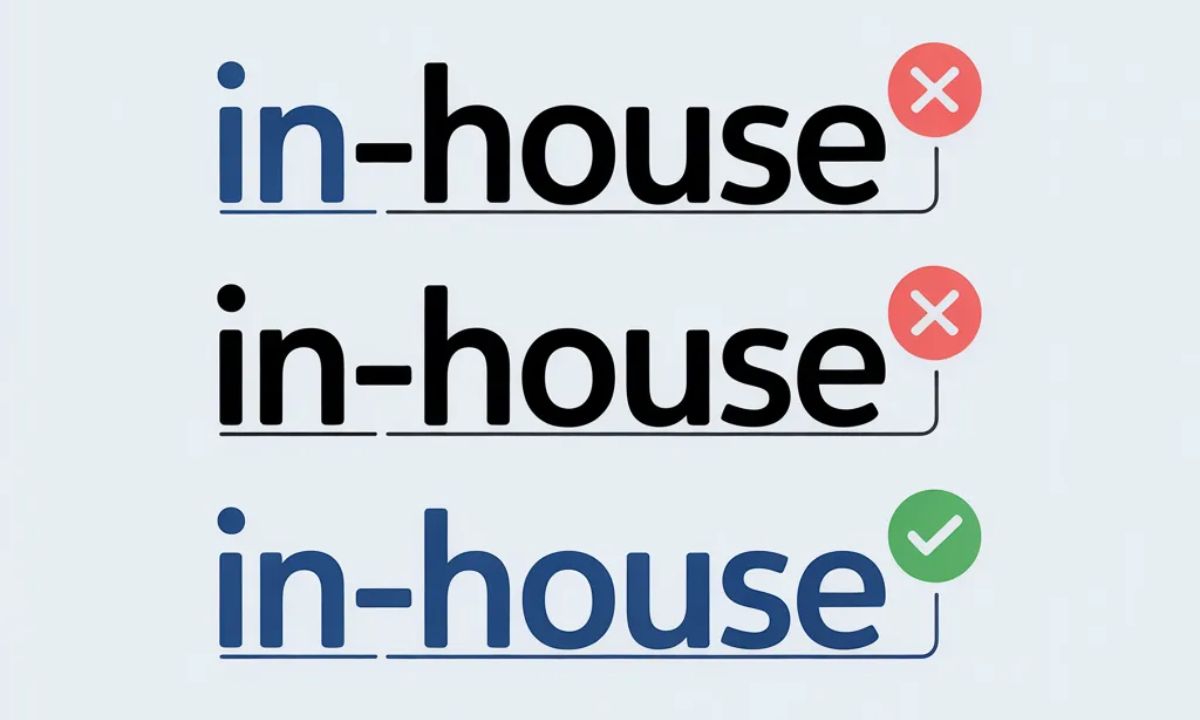
If you’ve ever written the word “inhouse”, “in-house”, or “in house”, you are not alone. Many English learners, writers, and even professionals get confused about which version is correct.
The truth is simple—but the usage is slightly nuanced.
👉 The correct and standard form in modern English is: in-house
However, understanding why this is correct and when the other forms appear will help you write more professionally and confidently.
In this complete guide, we will break down everything about inhouse or in-house or in house, including grammar rules, meanings, usage, examples, and common mistakes.
Inhouse or In-House or In House: Quick Answer
Let’s start with a simple breakdown:
| Form | Correct? | Usage |
| In-house | ✅ Correct | Standard adjective form |
| In house | ⚠️ Sometimes used | Informal / prepositional meaning |
| Inhouse | ❌ Incorrect | Not standard English |
👉 The most grammatically correct and widely accepted form is in-house.
What Does “In-House” Mean?
The term in-house refers to something that is done within an organization rather than outsourced or done externally.
Simple Definition:
In-house = something done internally within a company or organization.
Example meanings:
- Work done by company employees instead of freelancers
- Services provided internally
- Teams operating inside the organization
Example:
- “We have an in-house marketing team.”
- “The company handles legal issues in-house.”
Grammatical Basis for Saying “In-House”
Understanding grammar is key to mastering inhouse or in-house or in house.
1. Compound Adjective Rule
“In-house” is a compound adjective, formed by joining two words:
- in + house → in-house
When two words function together as a single adjective before a noun, English commonly uses a hyphen.
Example:
- in-house team
- in-house lawyer
- in-house training
👉 The hyphen helps clarity and readability.
2. Why the Hyphen is Important
Without the hyphen, meaning can become unclear.
Compare:
- ✔ in-house training (correct: internal training)
- ❌ in house training (can be misread as “training inside a house”)
The hyphen ensures the phrase is understood as a business or organizational term, not a literal location.
3. Grammar Rule in Simple Terms
When two words:
- act together as one idea
- come before a noun
👉 You usually hyphenate them.
That is why in-house is grammatically correct.
Is “Inhouse” Correct English?
Short answer: ❌ No
Why “inhouse” is incorrect:
- It is not recognized in standard dictionaries
- It breaks compound adjective rules
- It reduces readability and professionalism
However:
You may still see “inhouse” in:
- Informal writing
- Branding
- Social media posts
- Fast typing contexts
👉 But in academic, professional, and SEO writing, always avoid it.
What About “In House”?
The phrase “in house” (without hyphen) is not always wrong—but it changes meaning.
When “in house” is used correctly:
It is used as a prepositional phrase, not an adjective.
Example:
- “We discussed it in house before making a decision.”
Here, it means:
👉 inside the organization (as an action)
Key Difference:
| Form | Function | Meaning |
| in-house | adjective | internal team/service |
| in house | phrase | inside the organization (verb action context) |
Why “In-House” is the Better Version than “In House”
When comparing inhouse or in-house or in house, the hyphenated form wins in almost all formal writing situations.
1. Clarity
“In-house” removes ambiguity.
2. Professionalism
Businesses, legal documents, and corporate writing prefer it.
3. Standard English Usage
Style guides (APA, Chicago, etc.) support hyphenation.
4. SEO Advantage
Search engines understand “in-house” as the standard keyword form.
👉 That is why blogs, job postings, and corporate websites prefer it.
Examples of Using “In-House” in a Sentence
Let’s look at real-world usage of in-house:
Business Examples:
- We have an in-house development team.
- The company offers in-house training programs.
- All legal matters are handled by our in-house counsel.
Marketing Examples:
- Our in-house SEO experts improved traffic.
- The brand produces content using an in-house creative team.
HR Examples:
- Employees can access in-house workshops.
- The organization prefers in-house recruitment.
Common Mistakes with “Inhouse or In-House or In House”
Many learners confuse the three forms. Here are the most common errors:
❌ Mistake 1: Using “inhouse” in formal writing
✔ Correct: in-house marketing team
❌ Wrong: inhouse marketing team
❌ Mistake 2: Using “in house” as an adjective
✔ Correct: in-house training
❌ Wrong: in house training
❌ Mistake 3: Mixing forms in one document
Example:
- “We use inhouse developers and in house support.”
This looks unprofessional and inconsistent.
Why People Get Confused Between These Forms
The confusion around inhouse or in-house or in house happens due to:
1. Fast typing habits
People skip hyphens in casual writing.
2. Lack of grammar awareness
Many learners don’t know compound adjective rules.
3. Regional writing differences
Some informal American and online writing drops hyphens.
4. Search engine variations
Users search all three versions, increasing confusion.
SEO Perspective: Which Keyword Should You Use?
If you are writing blogs or content, here’s the SEO insight:
Primary keyword:
👉 in-house
Secondary keywords:
- inhouse
- in house
- what is in-house
- in-house meaning
Important SEO tip:
Even if users search “inhouse”, Google still ranks content optimized for “in-house” because it is the correct form.
Real-Life Usage in Business Communication
Let’s see how companies actually use in-house:
Technology Companies:
- “We use an in-house AI system for automation.”
HR Departments:
- “We prefer in-house hiring for key positions.”
Legal Departments:
- “All compliance is managed by our in-house legal team.”
Creative Agencies:
- “Our in-house designers handle branding projects.”
Voice Search Friendly Explanation
If someone asks:
👉 “What is in-house meaning?”
The answer is:
In-house means something that is done inside a company by its own employees instead of hiring outside services.
Simple Memory Trick
To remember inhouse or in-house or in house, use this rule:
👉 If it comes before a noun → use in-house
👉 If it describes an action → sometimes “in house”
👉 Never use “inhouse”
Conclusion
When it comes to inhouse or in-house or in house, the correct and professional form is clearly in-house.
It is grammatically correct, widely accepted, and used in business, academic, and professional writing worldwide.
While “in house” can appear in some informal contexts and “inhouse” may be seen online, neither is preferred in standard English.
Final takeaway:
👉 Always use in-house when writing professionally.
Frequently Asked Questions (FAQs)
What is the correct spelling: inhouse or in-house or in house?
The correct spelling is in-house with a hyphen.
Is “inhouse” correct English?
No, “inhouse” is not standard English and should be avoided in formal writing.
Can we write “in house” instead of “in-house”?
Yes, but only in specific contexts where it is used as a phrase meaning “inside the organization.”
What does in-house mean in business?
It means work or services performed by employees within the company instead of outsourcing.
Why is “in-house” hyphenated?
Because it is a compound adjective that modifies a noun, and hyphenation improves clarity.
Is “infront” the correct spelling in English?
No, “infront” is incorrect. The correct form is “in front.”
When is it appropriate to use “in front”?
Use “in front” when describing position or location.
Example:
- The car is parked in front of the house.