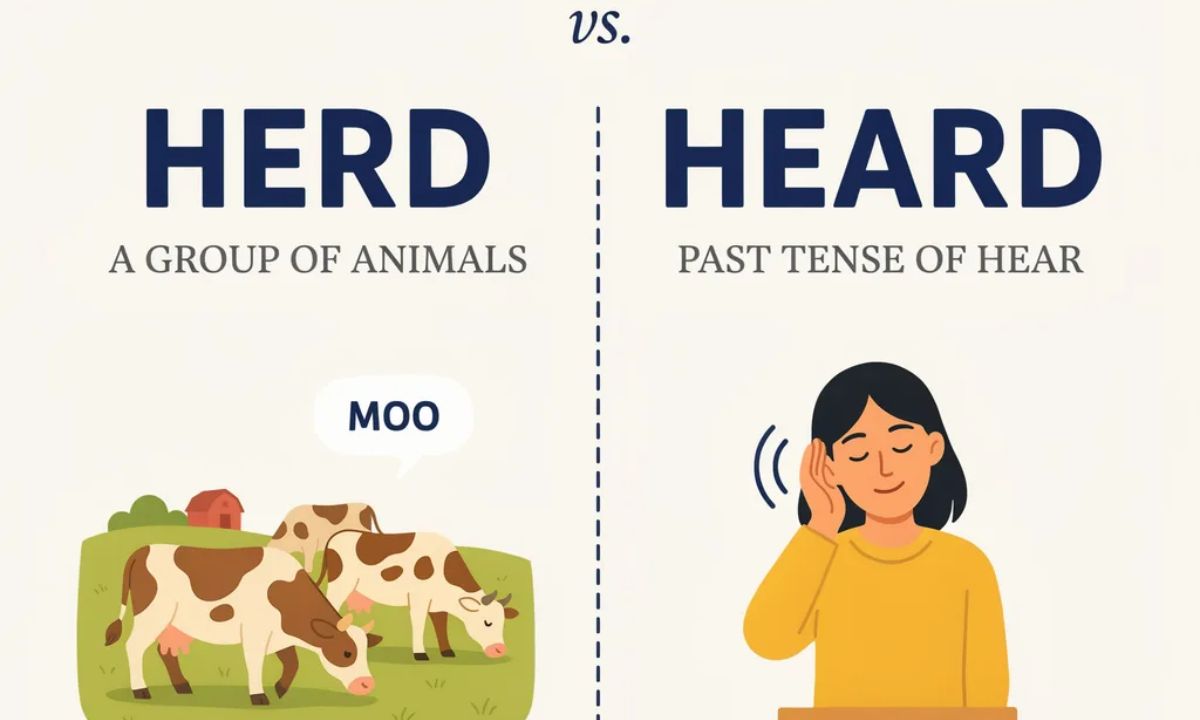
Many English learners struggle with herd or heard because both words sound exactly alike. However, their meanings are completely different. While heard relates to listening or receiving sound, herd refers to a group of animals or people moving together. Therefore, using the wrong word can quickly change the meaning of your sentence.
In this easy guide, you will learn the difference between herd or heard with simple explanations, practical examples, and memory tricks. Moreover, you will discover when to use each word confidently in everyday writing and conversation.
Why These Words Confuse So Many People
The confusion between “herd or heard” happens because both words sound exactly alike when spoken. In English, words that share the same pronunciation but have different meanings and spellings are called homophones. Since people hear the same sound, they often choose the wrong spelling while writing.
For example, someone may write, “I herd the news yesterday,” instead of “I heard the news yesterday.” Although the sentence sounds correct when spoken aloud, the spelling changes the meaning completely. This mistake is common among students, bloggers, and even native English speakers.
Another reason for the confusion is fast typing and autocorrect errors. Many people rely on pronunciation instead of understanding grammar rules. As a result, they mix these words in emails, social media posts, school assignments, and professional writing.
Learning the meaning of each word separately can solve this problem quickly. Once you understand how they function in sentences, remembering the correct spelling becomes much easier.
Why Confusion Happens
English contains thousands of confusing word pairs. However, “herd or heard” creates extra confusion because both words are short, simple, and frequently used in daily communication.
The word heard relates to hearing sounds or listening to something. On the other hand, herd usually refers to a group of animals such as cows, goats, sheep, or elephants. Despite their different meanings, the pronunciation remains identical.
People often learn spoken English before written English. Therefore, they recognize the sound first and only later discover the spelling difference. This learning pattern naturally causes spelling mistakes.
Additionally, English spelling rules are not always predictable. Many words evolved from old languages such as Germanic, Latin, and French. Because of this history, pronunciation and spelling do not always match perfectly.
For instance:
- “I heard a loud noise outside.”
- “The farmer moved the herd across the field.”
Both sentences sound similar when spoken quickly. Yet the meanings are completely different.
Homophones Explained Simply
Homophones are words that sound the same but have different meanings and spellings. They are one of the biggest reasons people struggle with English vocabulary and grammar.
The pair “herd or heard” is a classic example of homophones.
Here are a few other common homophones:
| Word 1 | Word 2 | Meaning Difference |
| Their | There | Possession vs location |
| Two | Too | Number vs also |
| Right | Write | Correct vs writing |
| Sea | See | Ocean vs vision |
| Herd | Heard | Group of animals vs listened |
Homophones can easily confuse readers if used incorrectly. Therefore, writers should always check the meaning of the sentence before choosing a spelling.
A simple trick is to focus on context:
- If the sentence talks about sound or listening, use heard.
- If the sentence talks about animals in a group, use herd.
This small habit can improve your grammar accuracy immediately.
The Root Cause: History and Sound Shifts
The confusion between “herd or heard” also comes from the history of the English language. Over hundreds of years, English pronunciation changed dramatically. However, spellings often stayed the same.
Linguists call these changes “sound shifts.” During these shifts, different words slowly developed similar pronunciations. As a result, many unrelated words became homophones.
The word heard comes from old Germanic roots connected to listening and hearing. Meanwhile, herd developed from ancient words related to groups of animals and farming life.
Although their origins differ, pronunciation changes made both words sound identical in modern English.
This historical evolution explains why English learners often feel frustrated. The spelling does not always clearly match pronunciation. Still, understanding the history can make these word pairs less confusing.
English is full of similar examples because the language borrowed vocabulary from many cultures over centuries.
Fun Fact Box: More Tricky Homophones
English has many tricky homophones besides “herd or heard.” Some are so confusing that even experienced writers occasionally make mistakes.
Here are some famous examples:
| Homophones | Meaning |
| Flour / Flower | Baking ingredient vs plant |
| Brake / Break | Stop movement vs damage |
| Knight / Night | Warrior vs evening time |
| Mail / Male | Post vs masculine gender |
| Peace / Piece | Calmness vs part of something |
Fun fact: The English language contains hundreds of homophone pairs. That is why spell-check tools cannot always catch mistakes. If you type “herd” instead of “heard,” the spelling checker may still accept it because “herd” is a real word.
Therefore, proofreading carefully is extremely important.
Reading books, articles, and conversations regularly can also train your brain to recognize the correct spelling naturally over time.
“Heard”: Meaning, Usage, and Examples
The word heard is the past tense of the verb “hear.” It means someone listened to or noticed a sound, voice, or piece of information.
People use heard when talking about sounds, conversations, music, news, or opinions.
Examples:
- I heard thunder during the storm.
- She heard her favorite song on the radio.
- We heard exciting news this morning.
- He heard footsteps behind the door.
- They heard the teacher clearly.
In all these examples, the word connects to listening or receiving sound through the ears.
You can also use heard when talking about information or rumors:
- I heard that your business is growing fast.
- Have you heard the latest update?
This word appears very often in spoken and written English. Therefore, learning its proper usage is extremely important for clear communication.
Definition & Grammar Role
Grammatically, heard functions as the past tense and past participle form of the verb “hear.”
Base verb: Hear
Past tense: Heard
Past participle: Heard
Examples in grammar:
| Verb Form | Example Sentence |
| Hear | I hear birds every morning. |
| Heard | I heard birds yesterday. |
| Have heard | I have heard that story before. |
The word can function in different sentence structures:
- Simple past tense
- Present perfect tense
- Passive voice
- Reported speech
Examples:
- She heard a strange sound.
- We have heard your concerns.
- The announcement was heard across town.
Because it is an irregular verb, it does not follow the normal “-ed” pattern used in regular verbs.
Idioms and Common Phrases Using “Heard”
The word heard appears in many popular English idioms and expressions. These phrases make conversations sound more natural and fluent.
Here are some common examples:
Heard It Through the Grapevine
This phrase means receiving information through rumors or unofficial communication.
Example:
“I heard it through the grapevine that they are opening a new restaurant.”
Loud and Clear
People use this phrase when they understand something completely.
Example:
“I heard you loud and clear.”
Haven’t Heard a Peep
This expression means receiving no communication or response.
Example:
“I emailed him yesterday but haven’t heard a peep since then.”
Music to My Ears
This idiom describes hearing something pleasant or exciting.
Example:
“The good news was music to my ears.”
Heard Enough
This phrase means someone no longer wants to listen.
Example:
“I’ve heard enough complaints for one day.”
Learning idioms improves both speaking and writing skills. Moreover, it helps you sound more natural in conversations.
Conclusion
Understanding the difference between “herd or heard” becomes simple once you focus on meaning and context. Although both words sound the same, they serve completely different purposes in English. The word heard relates to listening and sound, while herd refers to a group of animals.
Many people confuse these homophones because English pronunciation often differs from spelling. However, regular practice, reading, and sentence examples can help you remember the correct usage easily. Whenever you write, think carefully about the sentence meaning before choosing the word.
Mastering confusing word pairs like “herd or heard” improves your grammar, writing confidence, and communication skills. Over time, these mistakes become much easier to avoid.
FAQs
What is the difference between herd and heard?
“Herd” means a group of animals, while “heard” is the past tense of “hear.”
Is heard related to listening?
Yes. The word “heard” always relates to hearing sounds, voices, or information.
Can herd be used for people?
Sometimes. Writers may use “herd” informally to describe a large crowd of people, but it usually refers to animals.
Why do herd and heard sound the same?
They are homophones, which means they share the same pronunciation but have different spellings and meanings.
Which word is correct: I herd you or I heard you?
The correct sentence is “I heard you” because it relates to listening.
What is an easy trick to remember heard?
Remember that “heard” contains the word “hear,” which relates to sound and listening.