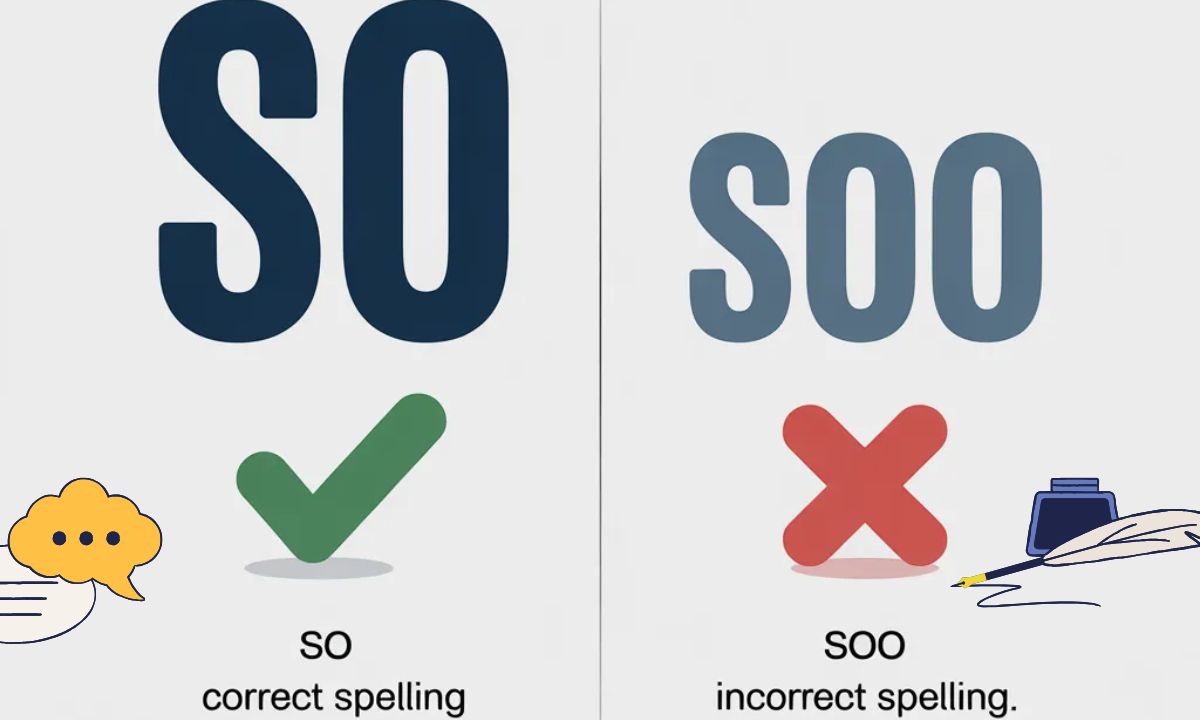
In today’s fast-paced digital world, even the smallest words can create big confusion. One such example is “so vs soo.” You’ve probably seen both used in texts, social media posts, and casual conversations. But which one is actually correct? And more importantly, when should you use each?
While “so” is a standard English word with clear grammatical roles, “soo” often appears as an expressive variation in informal communication. Because of this, many people—especially students and writers—struggle to understand whether “soo” is acceptable or just a mistake.
In this complete guide, you’ll learn the real difference between so vs soo, when to use each, and how to avoid common writing errors.
“So”Why It’s Always Correct
The word “so” is a fully recognized and grammatically correct term in English. It appears in dictionaries, academic writing, professional communication, and everyday speech.
Unlike “soo,” which is informal and context-dependent, “so” is universally accepted in all forms of communication.
👉 In simple terms:
If you’re ever unsure, “so” is always the safe and correct choice.
Functions of “So” in English
| Function | Example | Context |
| Adverb | “I’m so tired today.” | Modifies the adjective “tired” |
| Conjunction | “It rained, so we stayed inside.” | Links cause and effect |
| Intensifier | “That’s so cool!” | Adds emphasis |
| Interjection | “So? What happened next?” | Prompts continuation |
Is “Soo” a Real Word or Just Internet Slang?
The short answer: “Soo” is not a standard English word.
However, that doesn’t mean it’s completely useless. “Soo” exists as a form of internet slang, often used to exaggerate emotion or tone in casual communication.
The Urban Dictionary Definition
According to user-based definitions, “soo” is commonly used to:
- Stretch the sound of “so”
- Add emotional emphasis
- Mimic how people speak in real life
👉 Example:
- “I’m soo excited!” (extra excitement)
- “That’s soo funny!” (stronger reaction)
Soo vs So – Key Differences
| Feature | So | Soo |
| Grammar status | Correct English word | Informal slang |
| Usage | Formal + informal | Informal only |
| Meaning | Logical connector or intensifier | Emotional exaggeration |
| Acceptability | Always correct | Context-dependent |
| Professional writing | ✔️ Yes | ❌ No |
What Is “So” and How It Functions in English
The word “so” is incredibly versatile. It plays multiple roles in English grammar, which makes it one of the most commonly used words.
Grammatical Roles of “So”
1. Conjunction
Used to show cause and effect
👉 “I was tired, so I went to sleep.”
2. Adverb
Used for emphasis
👉 “She is so kind.”
3. Pronoun/Substitute
👉 “I think so.”
4. Intensifier
👉 “That’s so good!”
Common Uses of “So”
- Showing results: “It rained, so we stayed home.”
- Adding emphasis: “That’s so beautiful.”
- Continuing conversation: “So, what’s next?”
- Agreeing: “I hope so.”
Breaking Down “Soo”: Is It Even a Word?
Technically, “soo” is not recognized in standard dictionaries. However, it thrives in digital communication.
It’s best understood as a stylistic variation rather than a real word.
Why “Soo” Exists in Digital Communication
Let’s explore why people use “soo” despite it not being grammatically correct.
1. To Express Emotion
“Soo” adds emotional intensity.
👉 Example:
“I’m soo happy!” feels stronger than “I’m so happy.”
2. To Mimic Speech Rhythm
When we speak, we often stretch words naturally. “Soo” imitates that.
3. To Match Internet Culture
Online communication favors expressive, exaggerated styles.
4. To Show Personality
Using “soo” can make writing feel more personal, playful, or dramatic.
Contextual Comparison: “So” vs “Soo” Side by Side
| Sentence Type | With “So” | With “Soo” |
| Formal email | I am so grateful | ❌ Incorrect |
| Text message | I’m so tired | I’m soo tired |
| Essay | This is so important | ❌ Incorrect |
| Social media | That’s so cute | That’s soo cute |
When “Soo” Crosses the Line
The word “soo” may feel harmless in casual texting, but it can quickly become inappropriate depending on where and how it is used. Unlike “so,” which is a standard English word, “soo” is informal slang that relies heavily on tone and context. When used carelessly, it can weaken clarity, reduce professionalism, or even create misunderstandings in communication.
Understanding where “soo” crosses the line helps you avoid sounding unprofessional while still using it effectively in informal settings.
When It Works
- Text messages
- Social media posts
- Casual chats with friends
- Creative writing (dialogue)
When It Doesn’t
- Academic essays
- Job applications
- Business emails
- Professional reports
👉 Rule:
If the situation is formal, avoid “soo.”
“So” in Real-World English: Practical Examples
The word “so” is not just a grammar concept—it is a living part of everyday communication. You hear it constantly in conversations, see it in messages, and read it in formal writing. What makes “so” powerful is its flexibility: it adapts to tone, situation, and intent.
Below is a detailed look at how “so” works in real-world English, with practical examples from everyday speech, formal writing, and even media usage.
Everyday Conversations
In daily spoken English, “so” is extremely common because it helps people express emotions quickly and naturally. It often acts as an intensifier, making statements feel more personal and expressive.
1. Expressing Strong Emotions
People use “so” to emphasize feelings.
👉 Examples:
- “I’m so hungry.”
- “I’m so tired after work.”
- “That movie was so good!”
In these sentences, “so” intensifies the adjective. Without it, the sentence still makes sense, but it loses emotional strength.
2. Showing Reactions in Real Time
“So” is also used when reacting to something immediately.
👉 Examples:
- “That’s so interesting!”
- “That’s so funny!”
- “You’re so lucky!”
Here, the word reflects spontaneous emotional response, which is why it is so common in spoken English.
3. Keeping Conversations Natural
In casual speech, “so” often appears at the start or middle of sentences to make dialogue flow smoothly.
👉 Example:
- “So, what are you doing tonight?”
- “So I was thinking we should go out.”
This usage helps connect thoughts and makes speech sound more natural and less robotic.
Language Evolution: Should “Soo” Be Considered Acceptable?
Language constantly evolves. New forms appear, especially online.
The Case For “Soo”
- Reflects real speech patterns
- Adds emotional depth
- Popular in digital communication
The Case Against “Soo”
- Not grammatically correct
- Can appear unprofessional
- May confuse non-native speakers
The Final Verdict: How to Choose Between “Soo” and “So”
Choosing between so vs soo depends entirely on context.
Use “So” When:
- Writing professionally
- Communicating formally
- You want clarity and correctness
- You’re unsure about tone
Use “Soo” When:
- Texting friends
- Posting casually online
- Expressing strong emotions
- Writing informal dialogue
Quick Checklist: Choosing the Right Form
✔️ Is it formal? → Use so
✔️ Is it academic? → Use so
✔️ Is it casual? → “soo” is okay
✔️ Want emotional emphasis? → “soo” works
✔️ Not sure? → Always choose so
Case Study: How “Soo” Impacts Tone in Writing
Version 1 — Using “So”
“I am so excited to start this project.”
👉 Tone: Neutral, professional, clear
Version 2 — Using “Soo”
“I am soo excited to start this project!”
👉 Tone: Emotional, informal, enthusiastic
5 Common Mistakes with “Soo” and “So”
1. Using “soo” in formal writing
❌ “I am soo grateful for this opportunity.”
2. Overusing “soo”
Too much exaggeration reduces impact.
3. Mixing tones
Switching between formal and informal styles confuses readers.
4. Assuming “soo” is correct English
It’s not standard grammar.
5. Using “soo” in professional emails
Always avoid it in workplace communication.
How Context Changes the Meaning of “So” in Sentences
The word “so” may look simple, but its meaning can change significantly depending on context, tone, and sentence structure. In English, context is everything—it determines whether “so” shows emotion, logic, emphasis, or even serves as a conversational prompt. Because of this flexibility, understanding how context works is essential for using “so” correctly in both writing and speech.
1. “So” as a Logical Connector (Cause and Effect)
In formal and everyday English, “so” often connects two ideas where one is the result of the other.
👉 Example:
“It was raining, so we canceled the trip.”
Here, the context is logical and factual. There is no emotion—only a clear relationship between cause and effect. This is the most straightforward and widely accepted use of “so.”
2. “So” as an Emotional Intensifier
In emotional or expressive contexts, “so” strengthens adjectives or verbs.
👉 Example:
“I’m so happy today!”
In this case, the meaning depends heavily on tone. The word “so” does not show logic—it shows intensity. The stronger the emotion in the situation, the more powerful “so” becomes.
FAQs: Soo vs So
1. Is “soo” a correct word?
No, “soo” is not a standard English word. It is informal slang.
2. Can I use “soo” in writing?
Yes, but only in casual contexts like texting or social media.
3. Why do people use “soo”?
To express stronger emotions and mimic spoken language.
4. Is “so” always correct?
Yes. “So” is grammatically correct in all contexts.
5. Which should I use in exams?
Always use “so.”
Conclusion
The debate around so vs soo highlights how language evolves with technology and culture. While “soo” adds emotion and personality in casual communication, it lacks grammatical legitimacy.
On the other hand, “so” remains the gold standard—clear, correct, and universally accepted.
👉 Final takeaway:
- Use “so” for correctness and professionalism
- Use “soo” for expression and informality (when appropriate)
Mastering this small difference can significantly improve your writing clarity and tone—proving that even tiny words matter.