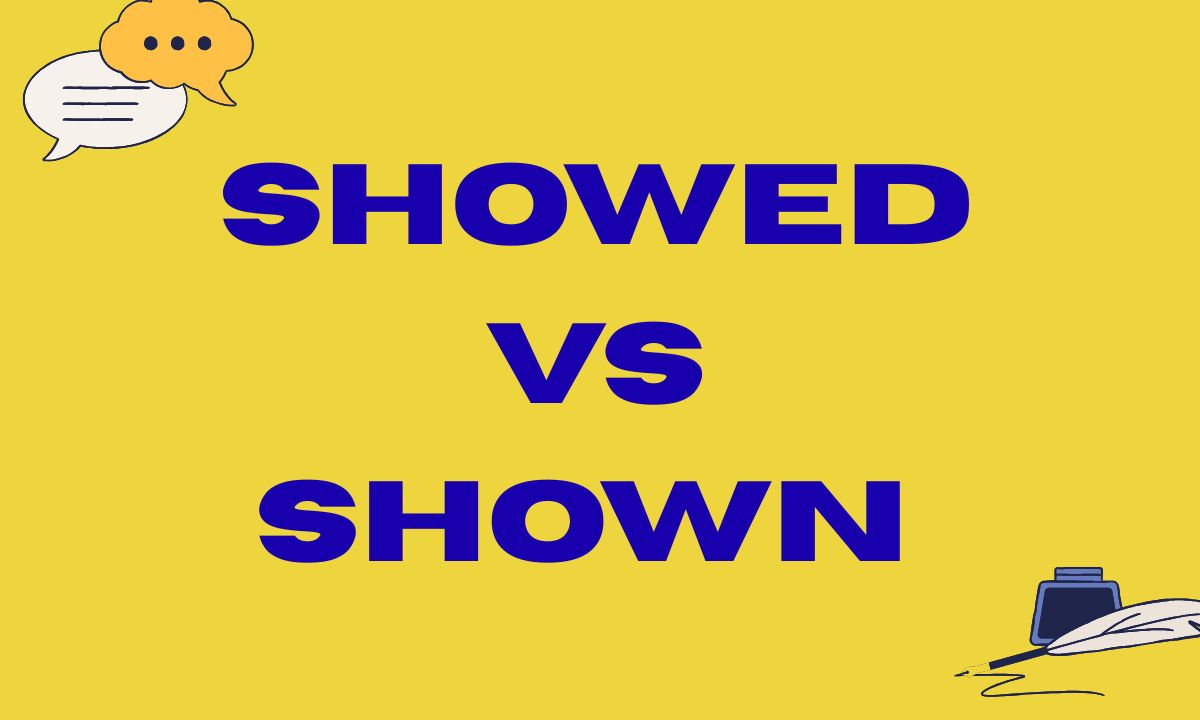
English grammar often confuses learners when two words look similar but follow different rules. One of the most common pairs that creates confusion is “showed” and “shown.” At first glance, both seem correct because they come from the same verb “show,” but their usage is completely different depending on tense and sentence structure.
The verb “show” is irregular, meaning it does not follow a simple “-ed” pattern in all forms. Its past form is “showed,” while its past participle is “shown.” This small difference plays a big role in sentence accuracy. “Showed” is used when talking about a completed action in the past, while “shown” is used with helping verbs like has, have, or had in perfect and passive structures.
Many English learners mistakenly say phrases like “I have showed him” instead of the correct form “I have shown him.” These errors may seem minor, but they can affect clarity and correctness in both writing and speaking—especially in exams, professional emails, and formal communication.
Quick Summary: Showed vs Shown
- Showed → Simple past tense (used for completed actions)
- Shown → Past participle (used with helping verbs like has, have, had)
👉 Example:
- I showed him the report yesterday.
- I have shown him the report already.
Understanding the Verb “Show”
The verb “show” is irregular, which means it doesn’t follow the standard -ed pattern in all forms.
Here are its main forms:
- Base form: show
- Past simple: showed
- Past participle: shown
👉 This irregular pattern is why people often get confused.
When to Use “Showed” Simple Past Tense
We use showed when talking about something that happened and finished in the past.
✔ Definition:
A completed action in the past without connection to the present.
📌 Examples:
- She showed me her new phone yesterday.
- The teacher showed us a video in class.
- He showed great courage during the match.
🧠 When to use it:
Use showed when:
- The time is clearly in the past
- No helping verb is used
- The action is complete
When to Use “Shown” Past Participle
Shown is the past participle form of “show.” It is never used alone.
✔ Definition:
Used with helping verbs to form perfect tenses.
📌 Examples:
- She has shown me the results.
- The document was shown to the manager.
- They had shown great improvement.
How to Spot “Shown” in Sentences
You can easily identify shown when you see:
- has
- have
- had
- is / was (passive voice)
👉 Example patterns:
- has shown
- have shown
- had shown
- was shown
Why “Shown” Matters in Perfect Tenses
Perfect tenses connect past actions with present or future meaning.
📌 Examples:
- Present Perfect: I have shown him the answer.
- Past Perfect: I had shown him the way before he asked.
- Future Perfect: I will have shown the plan by tomorrow.
👉 Without shown, these structures would be grammatically incorrect.
Breaking Down Perfect Tenses (with “Shown”)
\text{Perfect Tense Structure: } \text{have/has/had} + \text{past participle (shown)}
Perfect tenses always use:
- Helping verb (have/has/had)
- Past participle (shown)
⚖ “Have Showed” vs “Have Shown”
This is where most learners make mistakes.
❌ Incorrect:
- I have showed him the way.
✅ Correct:
- I have shown him the way.
👉 Why?
Because after have/has/had, we ALWAYS use the past participle “shown.”
🎤 Pronunciation Flow
- Showed → /ʃoʊd/ (rhymes with “road”)
- Shown → /ʃoʊn/ (rhymes with “own”)
👉 Small difference, but important in spoken English clarity.
🌍 Real-Life Examples and Usage Notes
- The police showed the suspect’s photo to witnesses.
- The results have been shown to be accurate.
- She showed interest in the project.
- The truth has been shown through evidence.
🌐 Regional Note (Important)
In both American English and British English, the rules are the same:
- “showed” = past simple
- “shown” = past participle
👉 There is no regional difference in meaning, only usage consistency matters.
⚖ Side-by-Side Comparison: Shown vs Showed
| Feature | Showed | Shown |
| Tense | Simple past | Past participle |
| Structure | Standalone verb | Needs helper verb |
| Example | I showed him | I have shown him |
| Usage | Completed action | Perfect/passive tenses |
📋 Quick Reference Summary Table
- Showed → past action
- Shown → perfect tense + passive voice
- “have showed” ❌ incorrect
- “have shown” ✅ correct
🧠 Quick Memory Tips
Here’s an easy trick:
👉 “Showed = Done yesterday”
👉 “Shown = Still connected to now”
Think:
- Showed → finished story
- Shown → continuing impact
⚠ Common Mistakes and How to Avoid Them
❌ Mistake 1: Using “shown” alone
- Wrong: I shown him the file
- Correct: I showed him the file
❌ Mistake 2: Using “have showed”
- Wrong: I have showed him
- Correct: I have shown him
❌ Mistake 3: Confusing passive form
- Wrong: The report was showed
- Correct: The report was shown
🏢 Case Study: Workplace Mix-Up
In a business email, someone wrote:
❌ “I have showed the report to the manager.”
This created confusion in formal communication.
Correct version:
✔ “I have shown the report to the manager.”
👉 In professional English, shown is always preferred in perfect tenses.
❓ FAQs About “Shown vs Showed”
1. Is “shown” correct English?
Yes, “shown” is the correct past participle of “show.”
2. Can I say “have showed”?
No, it is grammatically incorrect. Use “have shown.”
3. What is the difference in meaning?
There is no meaning difference, only grammatical structure difference.
4. Which is more formal?
“Shown” is more commonly used in formal writing.
5. Is “showed” past tense?
Yes, it is the simple past tense of “show.”
🏁 Final Thoughts
Understanding showed vs shown is not difficult once you break it down:
- Showed → simple, completed past action
- Shown → used with helping verbs in perfect and passive forms
Mastering this small difference instantly improves your grammar accuracy, especially in writing, exams, and professional communication.
If you remember just one rule, let it be this:
👉 “Have/has/had always needs ‘shown,’ never ‘showed.’”