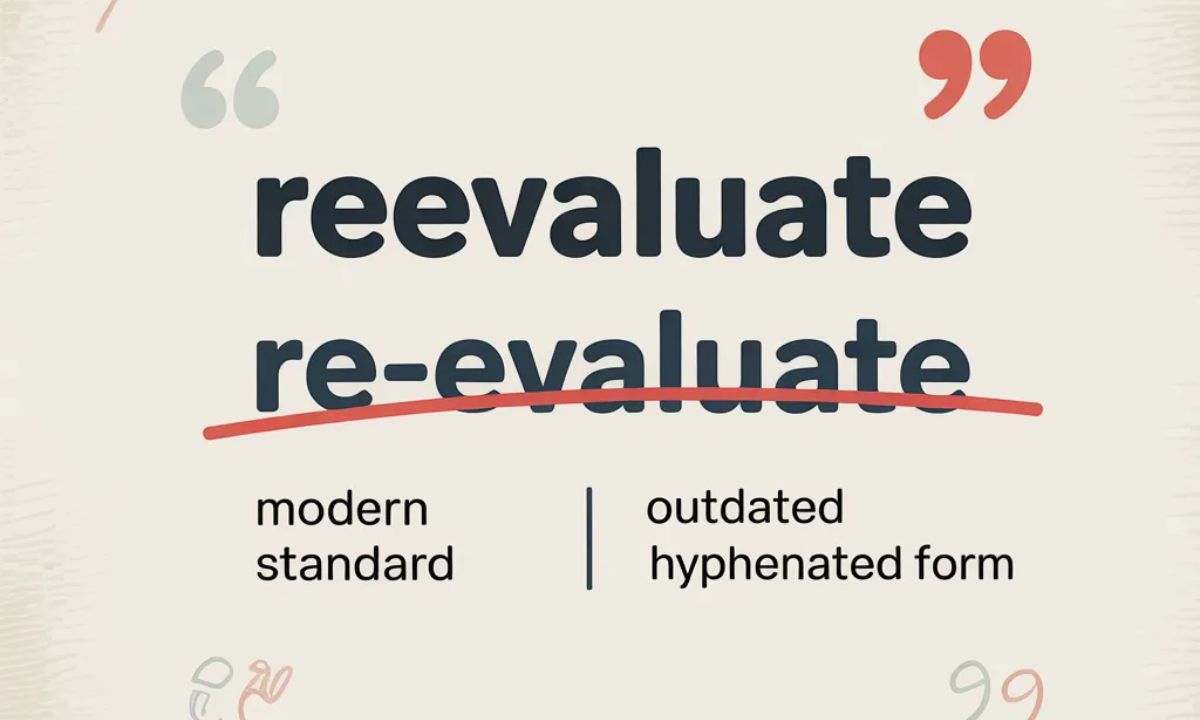
Many writers get confused between reevaluate or re-evaluate because both versions appear online, in books, and even in professional writing. One version uses a hyphen, while the other removes it completely. So which spelling is actually correct?
The short answer is simple: both “reevaluate” and “re-evaluate” are correct, but modern English increasingly prefers “reevaluate” without the hyphen.
People search for “reevaluate or re-evaluate” because English spelling rules often change over time. Words that once required hyphens gradually become closed compound words. That is exactly what happened here.
Define Reevaluate
Reevaluate means to examine, assess, or think about something again in order to make a better or updated decision.
It is commonly used when new information, changes, or results require a fresh judgment.
Example:
“We need to reevaluate the marketing strategy after the drop in sales.”
👉 In simple terms: reevaluate = evaluate again (modern, single-word form).
Define Re-Evaluate
Re-evaluate has the same meaning as reevaluate. It means to review or assess something again carefully, often after new developments or information.
The hyphenated form is more traditional and is still used in formal writing or older style conventions.
Example:
“The team decided to re-evaluate the project timeline.”
👉 In simple terms: re-evaluate = evaluate again (traditional, hyphenated form).
What Does “Reevaluate or Re-Evaluate” Mean?
Simple Definition
The terms reevaluate and re-evaluate both mean:
To examine, assess, or think about something again.
They describe the process of reviewing a decision, opinion, plan, strategy, or situation a second time.
Meaning in Everyday English
When you reevaluate something, you reconsider it carefully after getting new information or experiencing changes.
For example:
- A company may reevaluate its marketing strategy.
- A student may reevaluate career goals.
- A doctor may reevaluate a treatment plan.
Real-Life Example
Sentence example:
“After seeing the new data, the team decided to reevaluate the project.”
Here, “reevaluate” means the team reviewed the project again before making another decision.
Who Uses the Word?
Many professionals use reevaluate or re-evaluate regularly, including:
- Business managers
- Teachers
- Students
- Researchers
- Healthcare professionals
- Content creators
- AI and technology experts
Because modern industries constantly change, reevaluating decisions has become more important than ever.
Understanding Hyphenation in American English
Hyphenation plays an important role in American English because it helps improve clarity, pronunciation, and readability. However, English constantly evolves, and many words that once required hyphens are now written as single words. This is exactly why people often debate reevaluate or re-evaluate.
Understanding how hyphenation works makes it easier to choose the correct spelling confidently.
Why Hyphens Exist
Hyphens were originally created to connect words or prefixes in ways that prevented confusion. They act as small punctuation bridges between letters and word parts.
In English, hyphens commonly help readers:
- Understand pronunciation
- Avoid awkward double vowels
- Prevent misreading
- Separate complex word combinations
- Improve sentence clarity
For example:
- well-known author
- part-time worker
- re-enter the building
Without hyphens, some words become harder to read or visually confusing.
Modern Hyphenation Trend
Modern American English increasingly removes unnecessary hyphens. Over time, many compound words evolve through three stages:
- Open form
Example: data base - Hyphenated form
Example: data-base - Closed form
Example: database
The same trend affects words with prefixes like “re-,” “co-,” and “pre-.”
Because digital communication values speed and simplicity, many modern style guides now favor cleaner spellings without hyphens.
That is why reevaluate has become more common than re-evaluate in 2026.
The Prefix “Re-”: A Special Case
The prefix “re-” creates some of the most common hyphenation questions in English grammar.
What “Re-” Means
The prefix “re-” means:
“again” or “back”
When attached to a verb, it shows repetition or renewal.
Examples include:
- rewrite = write again
- rebuild = build again
- reconsider = consider again
- reevaluate = evaluate again
This prefix is extremely common in business, education, technology, and everyday communication.
When It Gets Tricky
Sometimes adding “re-” creates awkward letter combinations or pronunciation confusion. This is where hyphenation rules become important.
For instance:
- reenter vs re-enter
- reelect vs re-elect
- reevaluate vs re-evaluate
The double vowels can look strange to readers, even though they are grammatically correct.
Because of this, some writers prefer adding a hyphen for readability.
When to Use a Hyphen with “Re-”
Although modern English often removes hyphens, there are situations where using one is still recommended.
Use a Hyphen When:
1. The Word Looks Confusing Without It
A hyphen improves readability when multiple vowels appear together.
Examples:
- re-enter
- re-elect
- re-examine
Without the hyphen, readers may pause or misread the word.
2. The Meaning Could Change
Sometimes the hyphen prevents misunderstanding.
Example:
- recover = get better
- re-cover = cover again
The hyphen changes the meaning completely.
3. Formal Style Guides Require It
Some publishers and organizations still prefer hyphenated prefixes in formal writing.
Academic and print publications may choose traditional formatting rules.
Examples
Here are some common “re-” hyphen examples:
| Hyphenated Form | Meaning |
| re-enter | enter again |
| re-elect | elect again |
| re-examine | examine again |
| re-create | create again |
| re-evaluate | evaluate again |
These forms are still widely accepted in formal English.
When Not to Use a Hyphen
Modern writing often removes hyphens when the word is already easy to understand.
Skip the Hyphen When:
1. The Word Is Commonly Accepted Without It
Many “re-” words now appear as closed compounds.
Examples:
- rebuild
- reconsider
- reevaluate
- restart
- rewrite
These spellings look natural to modern readers.
2. Digital Writing Prefers Simplicity
Web content, SEO articles, and social media usually avoid unnecessary punctuation.
Shorter spellings improve:
- readability
- typing speed
- visual appearance
- mobile friendliness
3. Dictionaries Prefer the Closed Form
Many modern dictionaries now list “reevaluate” as the primary spelling.
Although “re-evaluate” remains acceptable, the non-hyphenated form is becoming dominant.
Reevaluation vs Re-evaluation: The Core Debate
The debate between reevaluation vs re-evaluation follows the same language evolution pattern.
Both nouns mean:
“the process of evaluating something again.”
Examples:
- project reevaluation
- policy re-evaluation
- financial reevaluation
However, modern American English increasingly favors:
- reevaluate
- reevaluation
instead of:
- re-evaluate
- re-evaluation
This shift reflects broader digital writing trends toward simplified spelling.
In 2026, most online publications, AI writing systems, and SEO-focused websites prefer the closed forms because they look cleaner and more modern.
Still, both versions remain grammatically correct, and professional writers may choose either depending on style preference or organizational guidelines.
Comparison Table: “Reevaluate” vs “Re-evaluate”
| Feature | Reevaluate | Re-evaluate |
| Correct Spelling? | Yes | Yes |
| Modern Usage (2026) | More commonly used | Less commonly used |
| Hyphen Usage | No hyphen | Includes hyphen |
| Writing Style | Modern, simplified | Traditional, formal |
| SEO Preference | Preferred for digital content | Less preferred in SEO writing |
| Readability | Cleaner and smoother | Slight visual pause due to hyphen |
| Dictionary Acceptance | Widely accepted | Also accepted |
| Business Writing Use | Very common | Still used in formal contexts |
| Academic Writing Use | Increasingly preferred | Still frequently used |
| AI & Grammar Tools | Often suggested as primary form | Accepted but secondary choice |
| Example Sentence | We need to reevaluate the plan. | We need to re-evaluate the plan. |
| Best Use Case | Blogs, SEO, modern writing | Formal documents, traditional style |
Quick Insight
Both reevaluate and re-evaluate are correct, but modern English trends in 2026 clearly favor the simplified form “reevaluate” because it improves readability and aligns better with digital writing standards.
Why “Reevaluate or Re-Evaluate” Is Important in 2026
Language trends continue evolving in 2026, especially in digital communication. That is why understanding reevaluate or re-evaluate matters more today.
Modern Writing Prefers Simplicity
Most online platforms now prefer shorter, cleaner spelling styles. As a result, reevaluate without the hyphen appears more frequently in:
- Blogs
- News websites
- Social media
- AI-generated content
- Business communication
This shift follows a common English pattern where hyphenated words eventually lose the hyphen.
AI and Search Engine Influence
AI writing tools and grammar software increasingly recommend “reevaluate” because it aligns with modern dictionary preferences.
Search engines also favor consistency. Therefore, using one standard spelling helps improve readability and SEO performance.
Professional Communication Trends
In workplaces, companies constantly reevaluate:
- Budgets
- Marketing plans
- Employee performance
- AI systems
- Customer strategies
Because industries evolve rapidly, the word has become common in business and technology discussions.
Social Media and Fast Communication
Social platforms encourage shorter writing styles. Therefore, many users naturally choose reevaluate over re-evaluate because it is faster and visually cleaner.
How Reevaluate or Re-Evaluate Is Used
Understanding usage is important because spelling alone does not explain the full picture.
Step 1: Identify Something That Needs Review
First, determine what requires reconsideration.
Examples include:
- Plans
- Decisions
- Goals
- Opinions
- Policies
Step 2: Gather New Information
People usually reevaluate after learning something new.
For instance:
- New research appears
- Business results change
- Technology improves
- Personal priorities shift
Step 3: Analyze the Situation Again
Next, examine the issue carefully.
This may involve:
- Comparing data
- Asking questions
- Reviewing outcomes
- Checking mistakes
Step 4: Make an Updated Decision
Finally, decide whether to continue, change, improve, or stop the original plan.
That is the complete reevaluation process.
Daily Examples of Reevaluate or Re-Evaluate
Here are practical daily examples showing how people use the word naturally.
- Career Planning
After graduating, many students reevaluate their career goals based on job opportunities. - Budget Decisions
Families often reevaluate monthly spending when prices increase. - Fitness Goals
Athletes reevaluate training programs after injuries or performance changes. - Business Strategies
Companies reevaluate marketing campaigns if sales begin falling. - Relationships
People sometimes reevaluate friendships after major life experiences.
These examples show why the term remains highly relevant in everyday life.
Common Mistakes People Make
Many writers misuse reevaluate or re-evaluate in small but noticeable ways.
1. Thinking Only One Spelling Is Correct
Mistake:
Believing “reevaluate” is correct while “re-evaluate” is wrong.
Correction:
Both are correct, but “reevaluate” is more modern.
2. Switching Spellings in the Same Article
Mistake:
Using both spellings inconsistently.
Correction:
Choose one style and stay consistent throughout your writing.
3. Adding Unnecessary Hyphens
Mistake:
Overusing hyphens in modern compound words.
Correction:
Most modern style guides now prefer closed compounds like “reevaluate.”
4. Misspelling the Word
Common incorrect forms include:
- reevalute
- reevalaute
- re-evalute
Correction:
Use either “reevaluate” or “re-evaluate.”
5. Using It in the Wrong Context
Mistake:
Using reevaluate when no second review exists.
Correction:
The word only works when something is examined again.
Expert Tips for Best Results
Professionals follow a few simple but powerful strategies when using reevaluate or re-evaluate in writing. These tips help improve clarity, consistency, and overall readability.
Use “Reevaluate” for Modern Writing
In most digital and online content, “reevaluate” is the preferred choice. It looks cleaner, reads faster, and fits modern writing trends. Blogs, websites, and SEO-focused content often favor this simplified form for better readability and user experience.
Stay Consistent
Once you choose a style—either reevaluate or re-evaluate—stick with it throughout your entire document. Mixing both forms can look unprofessional and distract readers.
Consistency improves:
- Writing clarity
- Professional tone
- Reader trust
Follow Your Style Guide
Different organizations and publishers follow specific grammar rules. Always check the required style guide before writing.
Common style guides include:
- AP Style
- Chicago Manual of Style
- Oxford Style
Each guide may have slightly different preferences for hyphenation, so following them ensures your writing meets professional standards.
Focus on Clarity
The most important rule is clear communication. Readers care more about understanding your message than strict punctuation rules. If a sentence reads better without a hyphen, the modern preference is usually to simplify it.
Is Reevaluate or Re-Evaluate Still Trending in 2026?
Yes, absolutely. In fact, the word is becoming even more common in 2026.
AI Technology Growth
Businesses constantly reevaluate AI systems to improve performance and accuracy.
Social Media Discussions
Influencers and creators often encourage followers to reevaluate habits, goals, and opinions.
Workplace Adaptation
Companies must regularly reevaluate strategies due to rapid market changes.
Education and Online Learning
Students and educators reevaluate learning methods because digital education continues evolving.
Future Language Trends
Experts predict “reevaluate” will become even more dominant over time, while “re-evaluate” may slowly decline in popularity.
However, both spellings will likely remain acceptable for years.
FAQs About Reevaluate or Re-Evaluate
What is the correct spelling: reevaluate or re-evaluate?
Both spellings are correct in English. However, modern writing increasingly prefers “reevaluate” without the hyphen because it follows current language simplification trends.
Why do some writers use re-evaluate?
Some writers use “re-evaluate” because older grammar styles traditionally included hyphens in compound words. Formal publications may still prefer this version.
Is reevaluate one word now?
Yes. In modern English, “reevaluate” is commonly treated as one word, especially in digital and professional communication.
Which spelling is more popular in 2026?
In 2026, “reevaluate” is generally more popular online because it matches modern SEO, readability, and AI writing preferences.
Can I use both spellings in one article?
It is better not to. Choose either “reevaluate” or “re-evaluate” and stay consistent throughout your content.
Is reevaluate used in business writing?
Yes. Businesses frequently use “reevaluate” when discussing strategies, budgets, marketing plans, and organizational goals.
Does Grammarly accept reevaluate?
Yes. Most grammar tools, including modern AI writing assistants, accept both spellings, although many suggest “reevaluate” as the preferred version.
Conclusion
The debate over reevaluate or re-evaluate is mainly about modern spelling style rather than correctness. Both forms are acceptable, and both mean to review or assess something again.
However, in 2026, reevaluate without the hyphen has become the preferred choice in most digital, business, and online writing environments. It looks cleaner, reads faster, and aligns with modern language trends.
Still, some formal writers and traditional publications continue using re-evaluate, especially when following older style guides.
The most important rule is consistency. Once you choose a spelling style, use it throughout your writing.
As AI, technology, and digital communication continue shaping English in 2026 and beyond, simplified spellings like reevaluate will likely become even more common worldwide.