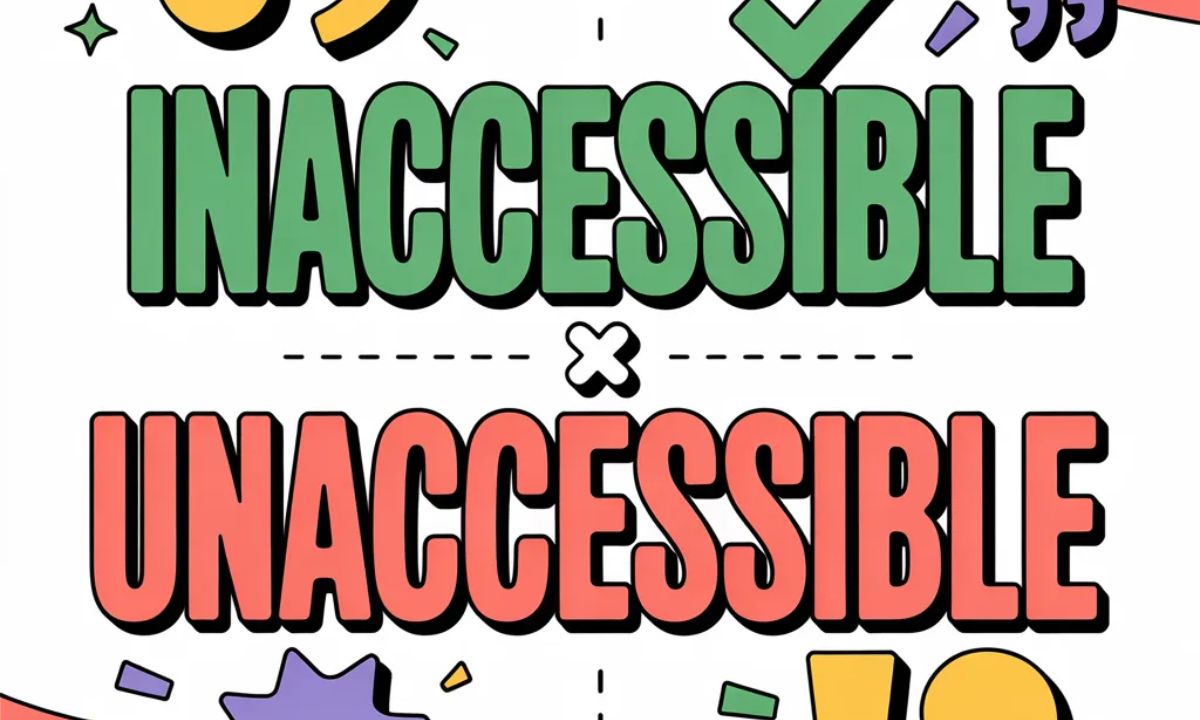
“Inaccessible or unaccessible” is a grammar question many English learners and writers search online every day. At first glance, both words may seem correct because English often uses prefixes like “un–” and “in–” to create opposite meanings. However, only one form is considered standard in modern English.
This confusion happens in blogs, academic writing, business communication, and even social media posts. Many people accidentally use “unaccessible” because it sounds logical, while others are unsure which version dictionaries actually accept.
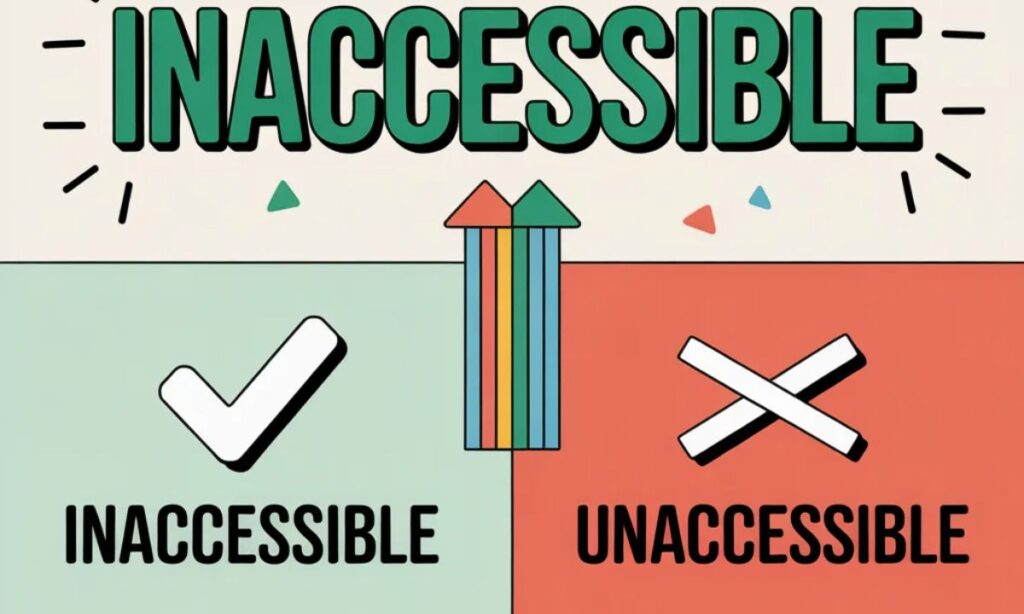
✅ Use “inaccessible”
❌ Avoid “unaccessible”
In 2026, using correct grammar matters more than ever.
DEFINE inaccessible or unaccessible?
What Does “Inaccessible” Mean?
Inaccessible means something cannot be reached, entered, understood, or used easily.
It is the correct and standard English word recognized by dictionaries and grammar experts.
Simple Definition
Inaccessible = difficult or impossible to access
Real-Life Example
- The mountain village became inaccessible after heavy rain.
- Some websites are inaccessible to visually impaired users.
- The old files were inaccessible without a password.
What About “Unaccessible”?
“Unaccessible” exists technically, but it is considered extremely rare and mostly incorrect in modern English usage. Most professional writers avoid it.
Who Uses “Inaccessible”?
The word is commonly used by:
- Teachers
- Journalists
- SEO writers
- Businesses
- Accessibility experts
- Government organizations
- Web developers
Because of its professional acceptance, “inaccessible” is the safer and smarter choice.
The Prefix Puzzle: Understanding “Un–” and “In–”
English uses many prefixes to create opposite meanings. Two of the most common negative prefixes are “un–” and “in–.” That is why many people become confused when choosing between inaccessible or unaccessible.
What Does “Un–” Mean?
The prefix “un–” usually means:
- Not
- Opposite of
- Lacking
Examples include:
- Unhappy
- Unfair
- Unclear
- Unfinished
This prefix is extremely common in everyday English.
What Does “In–” Mean?
The prefix “in–” also creates a negative meaning. It often appears in words that come from Latin roots.
Examples include:
- Incorrect
- Incomplete
- Invisible
- Inactive
The word “inaccessible” follows this Latin-based pattern.
Why the Confusion Happens
Since both prefixes can create opposites, some people naturally assume “unaccessible” should work too. However, English does not always follow perfect logic. Standard usage and history determine which form becomes accepted over time.
That is why “inaccessible” became the dominant and correct form in modern English.
Common Mistakes People Make
Many writers confuse inaccessible or unaccessible because both words seem grammatically possible. However, several common mistakes continue appearing in blogs, emails, and online content.
1. Using “Unaccessible” in Professional Writing
This is the most common error.
❌ The report was unaccessible.
✅ The report was inaccessible.
“Inaccessible” is the standard and accepted form in modern English.
2. Assuming Both Words Are Equally Correct
Some people believe both versions can be used interchangeably. In reality, “unaccessible” is considered rare and nonstandard.
Always choose “inaccessible” for formal communication.
3. Confusing Accessibility With Availability
“Inaccessible” means difficult to access, not completely unavailable.
Example:
- The website exists, but it is inaccessible to disabled users.
4. Using Overly Complex Sentences
Writers discussing accessibility sometimes create confusing sentences.
❌ The inaccessible implementation methodologies caused operational inefficiency.
✅ The system was inaccessible because it was too difficult to use.
Simple writing improves clarity.
5. Ignoring Modern Accessibility Contexts
Today, “inaccessible” is strongly connected to digital accessibility and user experience. Some writers still use the word only for physical locations.
Modern usage also includes:
- Websites
- Apps
- Online learning
- Digital documents
Comparison Table: Inaccessible vs Unaccessible
| Feature | Inaccessible | Unaccessible |
| Standard English Word | ✅ Yes | ❌ No |
| Dictionary Accepted | ✅ Widely accepted | ⚠ Rarely listed |
| Common in Professional Writing | ✅ Very common | ❌ Very rare |
| Used in SEO Content | ✅ Yes | ❌ Almost never |
| Sounds Natural to Native Speakers | ✅ Yes | ❌ Usually awkward |
| Recommended for Academic Writing | ✅ Yes | ❌ No |
| Seen in Modern Media | ✅ Frequently | ❌ Rarely |
| Best Choice in 2026 | ✅ Strongly recommended | ❌ Avoid using |
The Etymology: Tracing the Origins
To fully understand inaccessible or unaccessible, it helps to explore the word’s history.
The word “accessible” comes from the Latin word accessibilis, meaning “approachable” or “easy to reach.” It entered Middle English through French and later became common in formal English writing.
When English speakers created the negative form, they used the Latin-style negative prefix “in–” instead of “un–.”
So the standard form became:
- Accessible → Inaccessible
This structure matches many other Latin-origin English words.
Similar Examples
| Positive Word | Correct Negative Form |
| Accurate | Inaccurate |
| Visible | Invisible |
| Active | Inactive |
| Complete | Incomplete |
Because of this linguistic pattern, “inaccessible” sounds natural to native speakers while “unaccessible” sounds unusual.
Why “Inaccessible” Is the Correct Form
“Inaccessible” is the correct form because it is:
- Recognized by dictionaries
- Used in professional writing
- Accepted in academic English
- Preferred in journalism and publishing
- Common in SEO and online content
Major dictionaries and grammar authorities consistently recommend “inaccessible.”
Modern Standard Usage
Today, you will commonly see “inaccessible” in:
- Government documents
- Accessibility guidelines
- Websites
- Schools
- News articles
- Business communication
Examples:
- The website was inaccessible during maintenance.
- Some rural areas remain inaccessible after flooding.
- The information was inaccessible to beginners.
Why Professionals Prefer It
Professional writers avoid “unaccessible” because it can appear incorrect or awkward to readers. Using the standard form improves credibility and readability.
In SEO writing especially, correct grammar helps content rank better and appear more trustworthy.
Is “Unaccessible” Ever Acceptable?
Although “inaccessible” is clearly preferred, “unaccessible” has appeared occasionally throughout history.
However, its use remains extremely limited.
1. Historical Use
Older English texts sometimes included “unaccessible,” especially before grammar became more standardized.
In earlier centuries, English spelling rules were less strict. Writers often experimented with prefixes and word forms.
Still, “inaccessible” eventually became dominant.
2. Digital or Technical Errors
Today, “unaccessible” often appears because of:
- Typing mistakes
- Autocorrect problems
- AI-generated errors
- Non-native English writing
Many users accidentally create the word by adding “un–” automatically.
3. Dialectal or Informal Usage
In some informal speech patterns or regional dialects, people may still say “unaccessible.”
However, it is rarely accepted in formal communication.
Best Practice
For modern writing, always choose:
✅ Inaccessible
❌ Unaccessible
Regional and Dialectical Usage
The preference for “inaccessible” is strong across:
- American English
- British English
- Canadian English
- Australian English
No major English dialect officially prefers “unaccessible.”
Informal Speech Variations
In casual conversation, some speakers may use “unaccessible” simply because it feels logical. English learners also make this mistake frequently.
However, grammar checkers and professional editors usually flag it as incorrect or nonstandard.
Online Usage Trends
Search engines show far more results for “inaccessible” than “unaccessible.” This reflects real-world language habits and standard grammar expectations.
As global English becomes more standardized online, “inaccessible” continues growing stronger in usage.
Meaning and Nuance of “Inaccessible”
The word “inaccessible” has several related meanings depending on context.
1. Physically Difficult to Reach
This is the most common meaning.
Example:
- The cabin became inaccessible after the snowstorm.
2. Difficult to Understand
The word can describe information that feels too complex.
Example:
- The scientific article was inaccessible to general readers.
3. Emotionally Distant
Sometimes the word describes a person who seems hard to approach emotionally.
Example:
- The celebrity appeared inaccessible to fans.
4. Digitally Unusable
Modern technology often uses “inaccessible” to describe poor accessibility.
Example:
- The app is inaccessible to screen-reader users.
This meaning has become especially important in 2026 because digital accessibility standards continue expanding worldwide.
Real-World Usage Examples
Here are practical examples showing how “inaccessible” works in everyday communication.
Travel and Geography
- Several roads became inaccessible during heavy rain.
- The remote village remained inaccessible for weeks.
Technology
- The website was inaccessible because the server crashed.
- Some online tools are inaccessible without registration.
Education
- Complex textbooks can feel inaccessible to younger students.
- The lecture became inaccessible due to technical language.
Healthcare
- Medical services remain inaccessible in some rural regions.
- High treatment costs make healthcare inaccessible for many families.
Business
- Poor website design can make products inaccessible to users.
- Important customer data became inaccessible after the system failure.
Guidelines for Correct Usage
Following a few simple rules can help you avoid mistakes with inaccessible or unaccessible.
Always Use “Inaccessible” in Formal Writing
This is the safest and most professional option.
Avoid “Unaccessible” Completely
Even if some people use it informally, it is not recommended for:
- Blogs
- Academic papers
- SEO articles
- Emails
- Professional communication
Match the Context Carefully
Use “inaccessible” when describing:
- Places
- Information
- Technology
- Services
- Communication
Keep Sentences Clear
Simple writing improves readability.
Instead of:
- The documentation was rendered inaccessible due to excessive technical terminology.
Try:
- The instructions became inaccessible because they were too technical.
Think About Accessibility
In 2026, accessibility is more than grammar. It also relates to inclusive design, user experience, and digital equality.
Using language clearly and correctly helps make communication accessible to everyone.
Why Inaccessible or Unaccessible Is Important in 2026
The discussion around inaccessible or unaccessible is more important today because language quality directly affects communication online.
In 2026, grammar is closely connected to:
- SEO rankings
- AI-generated content
- Website accessibility
- Professional branding
- User trust
Search engines now analyze content quality more accurately. Incorrect or uncommon words may reduce readability and authority.
Digital Accessibility Growth
Modern businesses focus heavily on accessibility. Companies want websites, apps, and online services to be accessible for everyone.
Because of this trend, the word “inaccessible” appears frequently in:
- Web design
- Technology
- Education
- Healthcare
- Government policy
AI and Language Accuracy
AI writing tools also prefer standard vocabulary. Since “inaccessible” is recognized globally, it appears more often in grammar suggestions and search results.
Social and Cultural Relevance
People today expect clear communication. Using uncommon or outdated forms like “unaccessible” can confuse readers.
That is why understanding inaccessible or unaccessible matters in modern writing.
How Inaccessible or Unaccessible Is Used
Using the correct word is simple once you know the rules.
Step 1: Use “Inaccessible” in Formal Writing
Always choose “inaccessible” for:
- Essays
- Blogs
- Emails
- Reports
- SEO content
- Academic writing
Example:
- The building is inaccessible to wheelchair users.
Step 2: Avoid “Unaccessible” in Professional Content
Even though some dictionaries mention it historically, it sounds unnatural in modern English.
Incorrect:
- The road became unaccessible.
Better:
- The road became inaccessible.
Step 3: Use It for Physical Access
“Inaccessible” often describes places that cannot be reached.
Examples:
- An inaccessible island
- An inaccessible road
- An inaccessible office entrance
Step 4: Use It for Information or Technology
The word also describes content or systems that are difficult to use.
Examples:
- Inaccessible websites
- Inaccessible data
- Inaccessible language
This usage is very common in technology and digital accessibility discussions.
DAILY EXAMPLE inaccessible or unaccessible
• Website Accessibility
Many government websites become inaccessible during heavy traffic because servers cannot handle too many visitors.
• Travel Situations
Some mountain roads are inaccessible during winter storms due to snow and ice.
• School Learning
Complex textbooks can feel inaccessible for younger students without simple explanations.
• Mobile Apps
Apps without screen-reader support are inaccessible to blind users.
• Locked Files
A forgotten password can make important documents inaccessible.
Common Mistakes People Make
1. Using “Unaccessible” in Formal Writing
Many people assume both words are equal. However, “inaccessible” is the accepted standard.
Quick Correction
❌ Unaccessible website
✅ Inaccessible website
2. Thinking “Inaccessible” Only Refers to Places
The word also applies to ideas, systems, and information.
Example:
- The instructions were inaccessible to beginners.
3. Confusing Accessibility With Availability
“Inaccessible” means difficult to access, not unavailable.
Example:
- A website may exist online but still be inaccessible.
4. Overusing Complex Language
Some writers use difficult vocabulary when discussing accessibility, making content harder to understand.
Quick Fix
Use short and simple sentences.
5. Ignoring Digital Accessibility Standards
Businesses sometimes create websites that look attractive but remain inaccessible to disabled users.
This hurts user experience and SEO performance.
Expert Tips for Best Results
Use “Inaccessible” Consistently
Do not switch between inaccessible or unaccessible in the same article.
Follow Modern Dictionary Standards
Trusted dictionaries strongly favor “inaccessible.”
Keep Accessibility in Mind
When creating digital content:
- Add image descriptions
- Use readable fonts
- Improve navigation
- Write clear text
Write for Real People
Simple language improves readability and engagement.
Use Accessibility Tools
Professional writers and developers often test websites using accessibility checkers.
This improves user experience and search rankings.
Is Inaccessible or Unaccessible Still Trending in 2026?
Yes, the topic continues trending because accessibility has become a global priority.
AI Influence
AI tools now detect accessibility issues automatically. This increases awareness of terms like “inaccessible.”
Social Media Discussions
Platforms regularly discuss:
- Inclusive design
- Accessibility rights
- User-friendly content
- Digital equality
Because of this, the word “inaccessible” appears more often online.
Industry Adoption
Industries focusing on accessibility include:
- Technology
- Education
- Healthcare
- Government
- E-commerce
FAQs
What is inaccessible or unaccessible?
“Inaccessible” is the correct and commonly accepted English word. “Unaccessible” is rare and generally avoided in professional writing.
Which is grammatically correct: inaccessible or unaccessible?
“Inaccessible” is grammatically preferred in modern English and appears in major dictionaries and style guides.
Why do people say unaccessible?
Some people assume adding “un-” works the same as other English words. However, standard English favors “inaccessible.”
Is unaccessible wrong?
It is not completely wrong historically, but it sounds unnatural and outdated in modern usage.
Where is inaccessible commonly used?
The word appears in technology, education, travel, healthcare, accessibility discussions, and digital communication.
Why is accessibility important in 2026?
Accessibility improves inclusivity, user experience, SEO rankings, and legal compliance for websites and businesses.
Can inaccessible describe people?
Usually, the word describes places, systems, or information. However, it can sometimes describe someone emotionally distant or hard to approach.
Conclusion
The debate around inaccessible or unaccessible becomes simple once you understand modern English usage. While “unaccessible” may appear occasionally in older texts or informal speech, “inaccessible” is the correct, professional, and widely accepted word.
It is used across education, technology, healthcare, business, and digital accessibility discussions worldwide. Major dictionaries, grammar experts, and style guides all support “inaccessible” as the standard form.
In 2026, clear communication matters more than ever because AI tools, search engines, and readers all value accuracy and readability. Choosing the correct word improves trust, professionalism, and user understanding.
So whenever you are unsure between inaccessible or unaccessible, remember this simple rule:
✅ Use “inaccessible”
❌ Avoid “unaccessible”
That choice will keep your writing modern, polished, and grammatically correct.