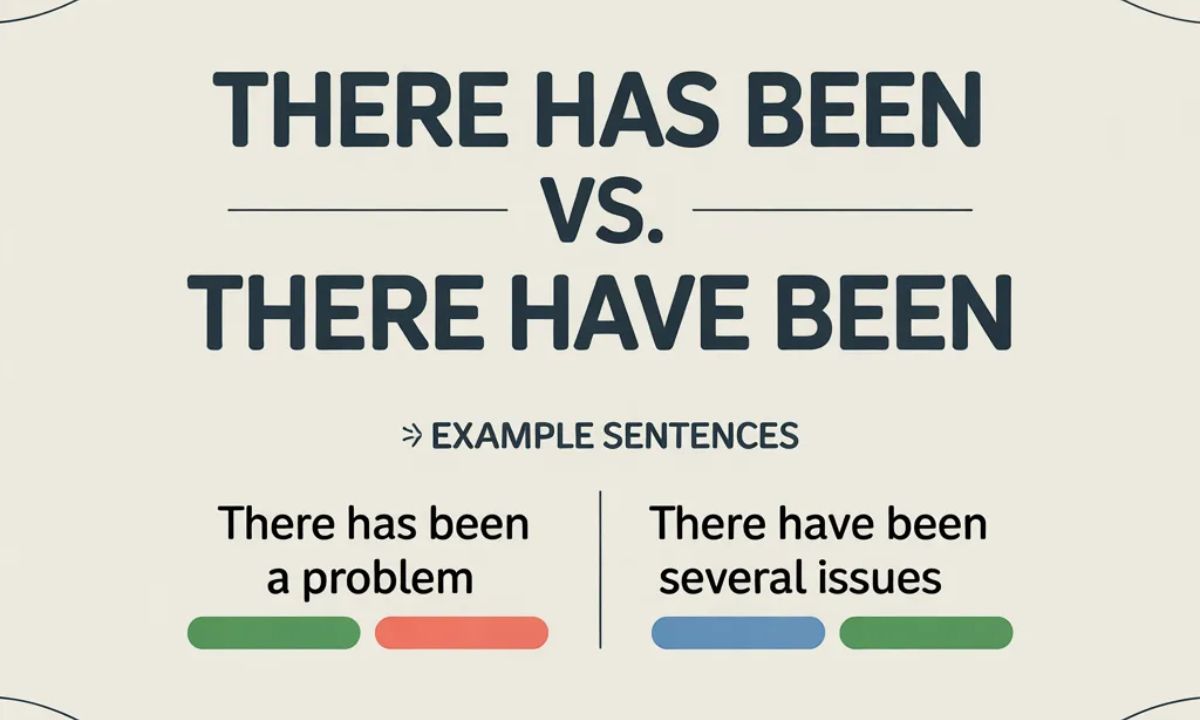
“There has been or have been” is one of the most searched grammar questions online because many English learners struggle with subject-verb agreement. At first glance, both phrases look correct. However, only one fits depending on the noun that follows.
This confusion happens in emails, essays, business writing, and even social media posts. Many people write sentences like “There have been a problem” or “There has been many issues” without realizing the grammar mistake.
The good news is that the rule is actually simple once you understand it clearly.
In this guide, you’ll learn the exact difference between “there has been” and “there have been,” when to use each one, common mistakes to avoid, daily examples, and expert grammar tips for 2026. By the end, you’ll be able to use both phrases naturally and confidently in spoken and written English.
Understanding ‘Has Been’ and ‘Have Been’
The phrases “has been” and “have been” are part of the present perfect tense in English grammar. They are used to describe actions, situations, or conditions that started in the past and still matter in the present.
The difference between them depends on the subject of the sentence.
- Has been → used with singular subjects
- Have been → used with plural subjects and pronouns like I and you
Examples
- She has been busy all day.
- They have been working since morning.
- I have been tired lately.
These verb phrases are extremely common in everyday English, professional writing, and online communication.
Why the Present Perfect Tense Matters
The present perfect tense connects the past with the present. It helps speakers explain experiences, recent changes, unfinished actions, and ongoing situations.
In modern communication, this tense matters because it makes sentences more natural and precise.
Common Uses of Present Perfect
- Talking about experiences
- I have been to Lahore many times.
- Describing ongoing situations
- She has been sick for two days.
- Explaining recent events
- There have been several updates today.
Why It’s Important in 2026
Today, strong grammar skills improve:
- Professional emails
- SEO content writing
- Social media communication
- AI-generated content accuracy
- Academic writing
Using present perfect tense correctly helps writing sound polished and trustworthy.
Rules for Using ‘Has Been’
Use “has been” when the subject is singular.
Singular Subjects Include:
- He
- She
- It
- Singular nouns
Correct Examples
- He has been very helpful.
- The teacher has been absent today.
- It has been raining all morning.
Key Rule
If the subject refers to one person, one thing, or one idea, use has been.
Common Mistake
❌ They has been waiting.
✔ They have been waiting.
Always match the helping verb with the subject.
Rules for Using ‘Have Been’
Use “have been” with plural subjects and specific pronouns.
Subjects That Use “Have Been”
- I
- You
- We
- They
- Plural nouns
Correct Examples
- We have been friends for years.
- The students have been studying hard.
- You have been very patient.
Quick Tip
If the subject means more than one, “have been” is usually correct.
Common Error
❌ She have been busy.
✔ She has been busy.
Small subject-verb mistakes can make writing look unprofessional.
Using ‘Had Been’ in Past Perfect Tense
The phrase “had been” belongs to the past perfect tense. It describes something that happened before another event in the past.
Structure
Subject + had been + verb/adjective
Examples
- They had been waiting before the bus arrived.
- She had been upset for days before the meeting.
- I had been working there before moving abroad.
Difference Between Present Perfect and Past Perfect
| Tense | Example | Meaning |
| Present Perfect | She has been tired. | Situation continues or matters now |
| Past Perfect | She had been tired before the exam. | Situation happened before another past event |
Understanding this difference improves sentence clarity.
Advanced Subject-Verb Agreement
Subject-verb agreement becomes harder in long or complex sentences. Many learners make mistakes because they focus on nearby words instead of the real subject.
Example 1
❌ There has been many problems recently.
✔ There have been many problems recently.
The main noun is problems, which is plural.
Example 2
❌ The list of items have been updated.
✔ The list of items has been updated.
The subject is list, not items.
Tips for Better Agreement
- Find the true subject first
- Ignore extra phrases temporarily
- Match singular subjects with singular verbs
- Match plural subjects with plural verbs
Strong subject-verb agreement improves grammar instantly.
Expanding Verb Phrases with Adverbs
Adverbs are often added between helping verbs and the main verb phrase to give extra detail.
Common Adverbs Used
- always
- never
- recently
- already
- just
- constantly
Examples
- She has always been kind.
- They have recently been promoted.
- I have never been there before.
Why Adverbs Matter
Adverbs make sentences more natural and expressive. They also improve tone and readability in writing.
Placement Rule
Adverbs usually come after has/have/had and before been.
✔ He has never been late.
✔ We have already been informed.
Using adverbs correctly helps sentences sound fluent and professional.
What Does “There Has Been or Have Been” Mean?
“There has been” and “there have been” are present perfect tense structures used to talk about something that existed or happened in the past and may still matter now.
Simple Definition
- There has been = used with singular nouns
- There have been = used with plural nouns
Meaning
These phrases describe the existence of someone, something, or an event.
Real-Life Examples
- There has been a mistake in the report.
- There have been many complaints this week.
Who Uses It?
These expressions are commonly used by:
- Students
- Teachers
- Business professionals
- Content writers
- English learners
- Journalists
Featured Snippet Answer
Use “there has been” with singular nouns and “there have been” with plural nouns. The verb must agree with the noun that follows it.
Why “There Has Been or Have Been” Is Important in 2026
Good grammar matters more than ever in 2026 because communication now happens across emails, AI tools, remote work platforms, and social media.
Incorrect grammar can make writing look unprofessional. Whether you are sending a job application, creating content, or posting online, proper sentence structure improves credibility.
AI writing tools also rely heavily on correct grammar patterns. If users misunderstand phrases like “there has been or have been,” AI-generated content may sound unnatural.
Search engines and grammar-checking software now prioritize clarity and readability. That means understanding correct English usage can improve:
- Academic writing
- SEO content
- Professional communication
- Online branding
- Social media engagement
As digital communication grows, grammar accuracy continues becoming more valuable.
How “There Has Been or Have Been” Is Used
Understanding usage becomes easy when you follow simple steps.
Step 1: Identify the Noun
Look at the noun after the phrase.
Example:
- There has been an error
- There have been many errors
Step 2: Check if the Noun Is Singular or Plural
- Singular noun → use has
- Plural noun → use have
Step 3: Match the Verb Correctly
Correct agreement is essential.
✔ There has been a delay.
✔ There have been delays.
Step 4: Read the Sentence Naturally
If the sentence sounds awkward, recheck the noun and verb agreement.
Daily Examples of “There Has Been or Have Been”
Here are some common real-life examples.
- There has been a power outage today.
This refers to one outage, so singular grammar is correct. - There have been many traffic problems this week.
“Problems” is plural, so “have been” is needed. - There has been an increase in prices recently.
“Increase” is singular. - There have been several updates to the app.
“Updates” is plural. - There has been confusion about the new policy.
“Confusion” acts as a singular noun.
These examples show how the noun determines the correct phrase.
Common Mistakes People Make
Many learners mix singular and plural structures. Here are the most common mistakes.
1. Using “Has” with Plural Nouns
❌ There has been many accidents.
✔ There have been many accidents.
2. Using “Have” with Singular Nouns
❌ There have been a problem.
✔ There has been a problem.
3. Ignoring the Main Noun
Sometimes long sentences create confusion.
❌ There has been many reasons for the delay.
✔ There have been many reasons for the delay.
4. Mixing Tenses Incorrectly
❌ There has being an issue.
✔ There has been an issue.
5. Overthinking Uncountable Nouns
Uncountable nouns usually take singular verbs.
✔ There has been progress.
✔ There has been information released.
Avoiding these mistakes improves grammar accuracy immediately.
Expert Tips for Best Results
Professional writers and editors use simple strategies to avoid grammar errors.
Focus on the Noun First
Always identify whether the noun is singular or plural before choosing the verb.
Practice with Everyday Sentences
Use these phrases during daily conversations and writing exercises.
Read the Sentence Aloud
Hearing the sentence often helps you spot grammar problems faster.
Learn Common Singular Nouns
Words like “information,” “advice,” and “news” are singular even though they may sound plural.
Use Grammar Tools Carefully
AI grammar checkers help, but understanding the rule yourself is still important.
Is “There Has Been or Have Been” Still Trending in 2026?
Yes, this grammar topic remains highly searched in 2026.
English learners around the world continue searching for simple grammar explanations because online communication is growing rapidly.
Social Media Impact
People write quickly on platforms like TikTok, X, LinkedIn, and Instagram. This increases grammar mistakes and creates more interest in quick grammar guides.
AI Influence
AI writing assistants now help millions of users create content. However, users still need grammar knowledge to check accuracy.
Industry Adoption
Businesses increasingly value strong communication skills. Correct grammar improves:
- Customer trust
- Professional reputation
- Content quality
- SEO performance
Future Trends
Grammar learning is becoming more interactive through AI tutors, voice tools, and smart writing apps. Still, basic grammar rules like “there has been or have been” remain essential.
FAQs About “There Has Been or Have Been”
What is the difference between “there has been” and “there have been”?
“There has been” is used with singular nouns, while “there have been” is used with plural nouns. The verb must always match the noun that follows in the sentence.
Is “there has been many” correct?
No, it is incorrect because “many” introduces a plural noun. The correct form is “there have been many.”
Can I use “there have been” for one thing?
No. “There have been” should only be used with plural nouns. Singular nouns require “there has been.”
Why do people confuse these phrases?
People often focus on the beginning of the sentence instead of the noun after the verb. Long sentences can also make subject-verb agreement harder to notice.
Is “news” singular or plural?
“News” is grammatically singular.
Correct example: “There has been good news today.”
Are these phrases used in professional writing?
Yes. These phrases are common in business emails, reports, academic writing, and formal communication.
How can I remember the rule easily?
Use this quick trick:
- One thing = has been
- More than one thing = have been
More Search Questions People Ask
When should I use “there has been”?
Use it when the noun is singular or uncountable.
Is “there have been” present perfect tense?
Yes, it is part of the present perfect tense structure.
Can AI grammar tools detect this mistake?
Most modern AI grammar tools can identify incorrect subject-verb agreement.
Is “there has been” formal English?
Yes. It is widely accepted in both formal and informal English.
Why is subject-verb agreement important?
It improves sentence clarity, professionalism, and readability.
Conclusion
Understanding “there has been or have been” becomes easy once you learn the basic rule. Use “there has been” for singular nouns and “there have been” for plural nouns.
Although many English learners confuse these phrases, regular practice makes them natural over time. Correct grammar improves communication in emails, school assignments, business writing, and online content.
In 2026, strong grammar skills remain important because AI tools, social media, and digital communication continue expanding worldwide. Mastering simple grammar rules like “there has been or have been” helps your writing sound clearer, smarter, and more professional.