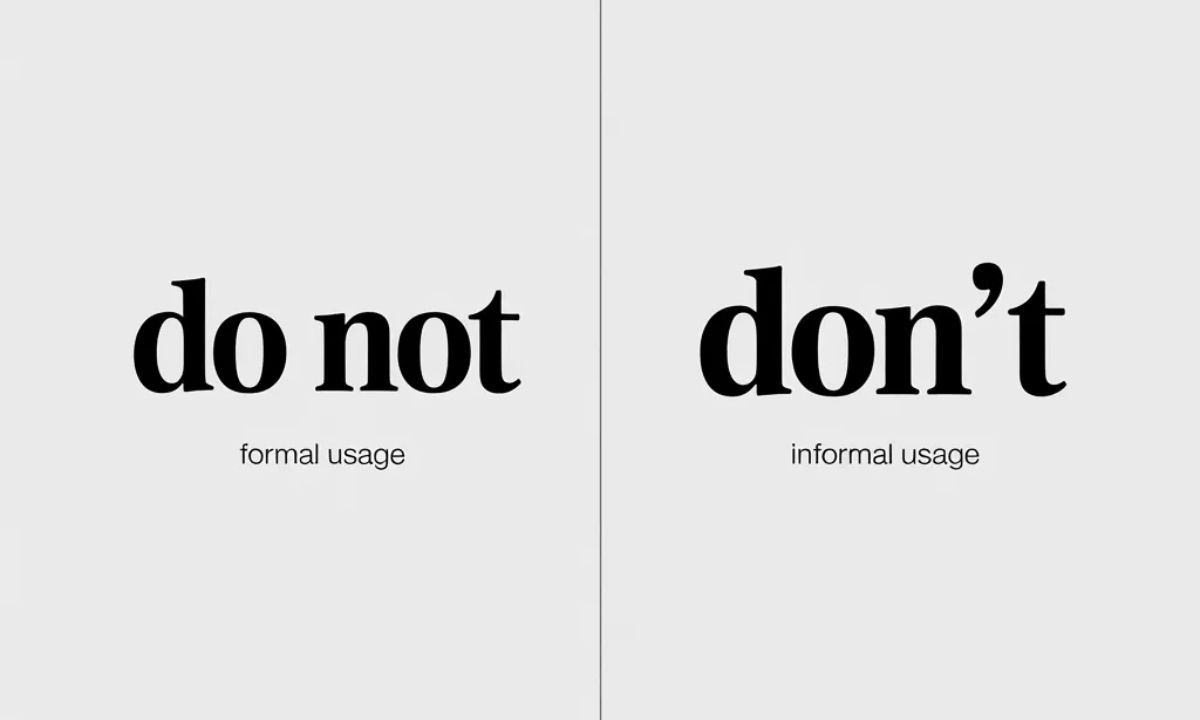
Understanding Do Not vs Don’t is essential if you want to speak and write English correctly and confidently. In everyday communication, both forms express negation, but they are not always interchangeable. Therefore, knowing when to use the full form “do not” and when to use the contraction “don’t” can significantly improve your grammar accuracy and writing tone.
Moreover, in formal writing, emails, academic content, and professional documents, “do not” often sounds more appropriate and clear. On the other hand, “don’t” is widely used in casual conversations, texting, and social media because it sounds natural and conversational. As a result, choosing the right form depends on context, tone, and audience.
In this guide, we will explore the difference between Do Not vs Don’t, their correct usage, examples, and simple grammar rules. Additionally, you will learn how native speakers use both forms in real-life communication so you can avoid common mistakes and write more naturally.
The Core Rule: How Negation Works With “Do”
The main difference in Do Not vs Don’t comes from how negation is formed in English grammar. Both “do not” and “don’t” are used to make a sentence negative, but they follow the same core rule: we use “do + not” + base verb to show refusal, denial, or prohibition in the present simple tense.
“Do not” is the full form, while “don’t” is the contraction. The meaning stays the same, but the tone changes. “Do not” sounds more formal, strong, and clear, while “don’t” feels more natural and conversational. For example, in professional writing you might say “Do not enter,” but in casual speech you would say “Don’t enter.”
Example 1
I do not like spicy food.
In this sentence, “do not” makes the verb “like” negative. It shows a clear dislike in a formal or neutral tone.
Example 2
She does not go to school on Sunday.
Here, “does not” is used because the subject is singular (she). It follows the same rule of negation in the present simple tense.
Example 3
We don’t watch TV at night.
This is the contraction form. “Don’t” makes the sentence sound more natural in everyday conversation.
Example 4
They do not understand the lesson.
This sentence is often used in formal communication or teaching situations to clearly express lack of understanding.
Example 5
He doesn’t eat meat.
“Doesn’t” is the contracted form of “does not.” It is commonly used in spoken English.
Example 6
You don’t need to worry about it.
This shows how “don’t” is used in friendly and supportive language to reduce formality and sound more relaxed.
Example 7
I do not agree with this decision.
This sentence carries a strong, formal tone, often used in arguments, essays, or official statements.
Imperative / Prohibition
In English, imperative sentences are used to give commands, instructions, or warnings. When we add “do not” or “don’t,” they become negative commands, also known as prohibitions.
“Do not” is usually used in formal warnings, signs, or written rules, while “don’t” is used in casual speech or friendly reminders. For example, a sign might say “Do not smoke,” but a friend might say “Don’t touch that.” Both expressions prevent an action, but the tone depends on context.
This is why understanding Do Not vs Don’t is important—it helps you choose the right level of formality in different situations.
Understanding ‘Do Not’ and ‘Don’t’
The difference between “do not” and “don’t” is mainly about formality and style, not meaning. Both expressions are used to create negation in the present simple tense. However, “do not” is the full form, while “don’t” is its contraction.
In simple terms, both mean the same thing, but they are used in different situations. “Do not” is often used in formal writing, instructions, and serious statements. On the other hand, “don’t” is commonly used in everyday speech, texting, and informal writing. As a result, choosing between them depends on your tone and audience.
Quick Comparison Table
| Feature | Do Not | Don’t |
| Form | Full form | Contraction |
| Tone | Formal, strong | Casual, friendly |
| Usage | Writing, rules | Speech, chats |
| Example | Do not enter | Don’t go there |
This table makes it easy to understand how both forms work in different contexts while keeping the same meaning.
Formality and Tone: Choosing the Right Expression
Formality plays a big role in deciding between do not vs don’t. In academic writing, official documents, or workplace communication, “do not” is preferred because it sounds more professional and clear.
For example:
- Do not share confidential information.
- Do not disturb during the meeting.
However, in daily conversations, “don’t” feels more natural and soft:
- Don’t worry about it.
- Don’t forget your keys.
Therefore, your choice depends on whether you want to sound formal or casual.
Examples of Inappropriate vs. Appropriate Usage
Sometimes using the wrong form can make your sentence sound awkward or too harsh.
Inappropriate (too formal for casual talk):
- Do not touch my phone (to a friend)
Appropriate:
- Don’t touch my phone
Inappropriate (too casual for formal writing):
- Don’t submit the report late (in official email)
Appropriate:
- Do not submit the report late
So, always match your expression with the situation.
Grammatical Rules for ‘Do Not’ and ‘Don’t’
Both forms follow the present simple negative structure:
do/does + not + base verb
- I do not play
- She does not play
- They do not play
In contraction form:
- I don’t play
- She doesn’t play
- They don’t play
The main rule is simple: always use the base form of the verb after “do not” or “don’t.”
Pronoun Influence
Pronouns decide whether we use do not/don’t or does not/doesn’t.
- I / You / We / They → do not / don’t
- He / She / It → does not / doesn’t
Examples:
- They don’t like coffee.
- He doesn’t like coffee.
- I do not agree with this idea.
This rule is important for correct grammar usage.
Verb Agreement
After do not / don’t, the verb must always stay in its base form. You should never add -s or -ed.
Correct:
- She doesn’t go to school.
Incorrect:
- She doesn’t goes to school ❌
This rule ensures proper subject-verb agreement in English.
Emphasis in Writing
“Do not” is often used when you want to create strong emphasis. It sounds direct, serious, and authoritative.
For example:
- Do not enter without permission.
- Do not ignore safety rules.
On the other hand, “don’t” reduces intensity and makes the sentence softer:
- Don’t worry too much.
- Don’t be late.
So, if you want strong impact, use “do not.” If you want a friendly tone, use “don’t.”
Common Mistakes and Misconceptions
One of the most common mistakes learners make with Do Not vs Don’t is thinking they are different in meaning. In reality, both express the same negation, but the difference lies in tone and formality.
Another frequent error is using the wrong verb form after “do not” or “don’t.” Many learners mistakenly add “-s” or “-ed” to the main verb, which is incorrect in English grammar.
Incorrect examples:
- She doesn’t goes to school ❌
- I don’t likes coffee ❌
Correct examples:
- She doesn’t go to school ✔
- I don’t like coffee ✔
Additionally, some learners overuse “do not” in casual speech, which can make their English sound unnatural or too formal.
Quick Test for Readers
Try to choose the correct option in each sentence:
- I (don’t / do not) like spicy food in casual conversation.
- Please (don’t / do not) enter the room (formal sign).
- He (don’t / doesn’t) play football.
- We (don’t / do not) need any help in an email.
- She (don’t / doesn’t) understand the lesson.
Answers:
- don’t
- do not
- doesn’t
- do not
- doesn’t
Practical Tips for Correct Usage
To master Do Not vs Don’t, follow these simple tips:
- Use “do not” in formal writing like essays, emails, notices, and rules.
- Use “don’t” in daily conversations and informal writing.
- Always keep the verb in its base form after negation.
- Match the tone with your audience (formal vs casual).
- Avoid mixing contractions in very serious documents.
These small habits can instantly improve your grammar accuracy and writing style.
Example Exercises
Fill in the blanks with do not / don’t / doesn’t:
- I ______ want to go outside today.
- She ______ like horror movies.
- Please ______ forget to submit your assignment.
- They ______ agree with the decision.
- He ______ eat fast food often.
Answers:
- don’t
- doesn’t
- do not / don’t
- don’t
- doesn’t
These exercises help reinforce correct usage in different contexts.
Case Studies: Real-World Usage
In real-life communication, choosing between do not vs don’t depends heavily on context.
Case 1: School Rules
A school notice says:
- “Do not run in the corridors.”
Here, “do not” is used because rules require a formal and strict tone.
Case 2: Friendly Conversation
A friend says:
- “Don’t worry, everything will be fine.”
“Don’t” is used because it sounds supportive and informal.
Case 3: Workplace Email
A manager writes:
- “Do not share this document outside the company.”
This ensures seriousness and authority.
Case 4: Social Media Chat
A user texts:
- “Don’t forget the party tonight!”
This is casual and friendly.
These examples show that both forms are correct, but their effectiveness depends on where and how you use them.
Conclusion
In summary, the difference between Do Not vs Don’t is not about meaning but about tone, formality, and context. Both are used to make negative sentences in English, yet they serve different communication purposes. “Do not” is more formal, direct, and suitable for written rules, academic content, and professional communication. In contrast, “don’t” is informal, natural, and widely used in daily conversations, texting, and social media.
Therefore, mastering when to use each form helps you sound more natural and confident in English. Moreover, it improves your writing clarity and ensures your message matches the right audience. By practicing correct grammar rules and paying attention to tone, you can easily avoid common mistakes and communicate more effectively in both formal and informal situations.
FAQs
What is the difference between Do Not and Don’t?
Both have the same meaning, but “do not” is formal while “don’t” is informal and commonly used in spoken English.
Can I use Don’t in formal writing?
It is better to avoid “don’t” in formal writing such as academic essays, business emails, and official documents. Use “do not” instead.
Is Do Not more correct than Don’t?
No, both are correct. The choice depends on tone and context, not grammar correctness.
When should I use Don’t?
Use “don’t” in casual conversations, texting, social media, and friendly communication.
Why do we use Do Not instead of Don’t?
We use “do not” to sound more formal, serious, or authoritative, especially in rules, instructions, and official statements.