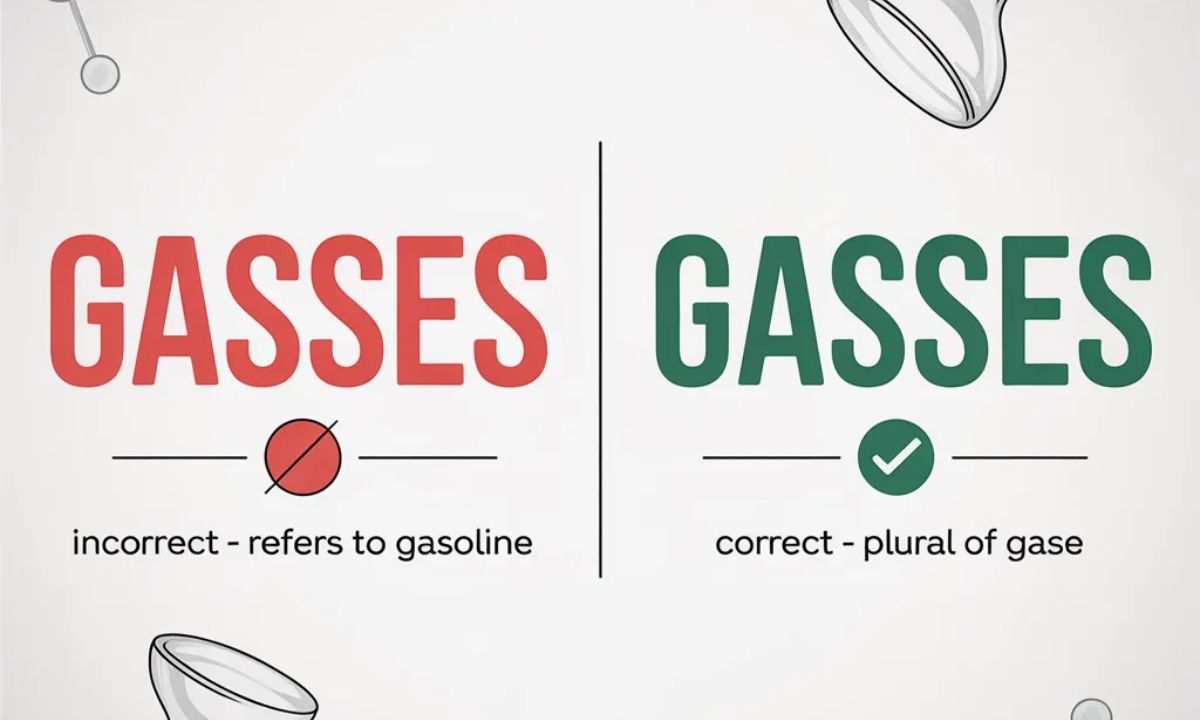
When it comes to Gasses vs Gases, many learners often get confused because both look similar, but their meanings and usage are completely different. However, understanding the difference is very important for clear and correct English writing. Moreover, these words are commonly used in science, grammar, and everyday communication, which makes them even more confusing for beginners.
In simple terms, “gases” is the correct plural form of “gas,” while “gasses” is used as a verb related to the action of giving off gas or inhaling gas. Therefore, knowing when to use each word can significantly improve your grammar accuracy. Additionally, in this guide, we will break down meanings, usage rules, and real-life examples so you can never mix them up again.
Gases or Gasses?
Many English learners get stuck when they see “gases” and “gasses” because both words look almost identical. However, they are not interchangeable. In fact, each word has its own correct meaning and usage.
Moreover, the difference mainly comes from grammar rules and verb forms, which makes it important to understand them clearly. Once you learn how each one works, you will easily avoid one of the most common English mistakes.
What is the Difference Between Gases and Gasses?
The main difference between gases vs gasses lies in their function in a sentence.
“Gases” is the plural noun of “gas.” It refers to more than one type of gas or multiple gas substances. For example, oxygen and carbon dioxide are gases.
On the other hand, “gasses” is the verb form of “gas.” It is used when someone or something releases gas or becomes exposed to gas. It often appears in scientific or chemical contexts.
Additionally, the spelling difference comes from English grammar rules. Normally, we add “-es” to nouns ending in “-s” to make them plural, while “-ss” + “es” is used for certain verb forms.
When to Use Gases
You should use “gases” when talking about more than one gas or different types of gases. It is strictly a noun.
Use it in contexts like:
- Science and chemistry
- Environmental discussions
- Air composition
- Industrial emissions
Furthermore, it is commonly used when referring to elements in the air or chemical reactions.
When to Use Gasses
You should use “gasses” when describing an action related to gas. It works as a verb, usually in the present tense.
It is used when:
- Something releases gas
- A system emits fumes
- A chemical process produces gas
- A subject is exposed to gas in experiments
Moreover, this form is less common in everyday speech but important in scientific writing.
Examples of “gasses”
Here are simple examples to understand how “gasses” is used:
- The chemical reaction gasses the container quickly.
- The factory gasses harmful fumes into the air.
- The material gasses when it is heated.
- The experiment gasses carbon dioxide during the process.
In addition, these examples show action, not quantity.
Examples of “gases”
Now, here are examples of “gases” used as a noun:
- Oxygen and nitrogen are important gases in the atmosphere.
- Greenhouse gases contribute to global warming.
- Different gases are used in medical treatments.
- The balloon contains several gases.
Therefore, these examples clearly refer to multiple types of gas substances.
Is Gas a Noun or a Verb?
The word “gas” is mainly used as a noun, but it can also work as a verb in specific contexts. However, its noun usage is far more common in everyday English.
As a noun, “gas” refers to a substance that has no fixed shape and spreads to fill space, such as oxygen, carbon dioxide, or natural gas. For example, we breathe oxygen gas, and cooking gas is used in homes.
On the other hand, as a verb, “gas” is used in more technical or scientific situations. It means to expose something to gas or to treat with gas, often in industrial or laboratory processes. Additionally, this verb form is less common in daily conversation but important in chemistry and engineering contexts.
So, in simple terms, gas = mostly noun, but it can function as a verb when describing an action involving gas exposure or release.
Instances of “Gasses” in a Sentence
The word “gasses” is used as a verb, and it usually describes the action of releasing or producing gas. It often appears in scientific, chemical, or industrial situations.
Here are some clear examples:
- The factory gasses toxic fumes into the atmosphere during production.
- The chemical reaction gasses carbon dioxide when heated.
- The engine gasses exhaust as it runs continuously.
- The lab experiment gasses the container to study reactions.
- The material gasses rapidly when exposed to high temperature.
Moreover, these sentences show action being performed, not naming substances. Therefore, “gasses” should always be used carefully in contexts where something is actively releasing gas or undergoing a gas-related process.
Why This Common Confusion Exists
The confusion between gases vs gasses exists because both words look almost identical, yet they follow different grammar rules. Moreover, English spelling patterns can be tricky, especially when a word can act as both a noun and a verb. As a result, learners often mix them up while writing or speaking.
Additionally, both words come from the same root “gas,” which makes them even more confusing. However, their usage depends on context, not spelling alone. Therefore, understanding sentence structure is key to avoiding mistakes.
Understanding the Core Difference
The core difference between gases vs gasses is simple when broken down:
- Gases (noun): The plural form of “gas,” used to describe more than one type of gas.
- Gasses (verb): The action form of “gas,” used when something releases or produces gas.
In other words, “gases” shows quantity, while “gasses” shows action. Moreover, this distinction helps you choose the correct word depending on whether you are talking about things or actions.
When to Use “Gases”
You should use “gases” when referring to multiple types or amounts of gas. It always works as a noun.
Additionally, it is widely used in scientific, environmental, and general English contexts.
In Science and Chemistry
In science, “gases” is commonly used to describe elements or compounds in gaseous form. For example:
- Oxygen and nitrogen are important gases in the air.
- Greenhouse gases trap heat in the atmosphere.
- Noble gases are chemically stable elements.
Moreover, scientists use this term to classify substances that exist in gas form under normal conditions.
In Daily Life
In everyday life, we also use “gases” frequently when talking about air, fuel, or pollution.
For example:
- Cooking gases are used in homes for heating.
- Vehicle exhaust contains harmful gases.
- Air contains different gases we cannot see.
Therefore, “gases” is the correct and most common form in daily communication.
Scientific Fact
From a scientific perspective, gas is one of the four main states of matter, along with solid, liquid, and plasma. Furthermore, gases have no fixed shape or volume and expand to fill any container.
Additionally, gases are made up of tiny particles that move freely, which is why they spread easily in the air. This scientific behavior explains why the term “gases” is used in plural form when referring to multiple types or mixtures of gas substances.
Grammar Behind the Double “S”
The spelling difference in gases vs gasses mainly comes from English grammar rules. Specifically, it is connected to how verbs and nouns are formed when a word ends in “-s.” Moreover, English often uses spelling changes to keep pronunciation clear and consistent. That is why the double “s” appears in certain forms.
Doubling Consonants Rule
In English grammar, consonants are sometimes doubled to protect pronunciation or show tense changes in verbs. For example, when a word ends in a vowel + consonant pattern and changes form, the final consonant may be doubled.
In the case of “gas” → “gasses,” the “s” is doubled because it follows verb conjugation rules in some contexts. This helps maintain correct pronunciation and avoids confusion with the noun plural “gases.”
Additionally, this rule is more common in verbs than nouns, which is why “gasses” functions as an action word.
Quick Comparison Table
Here is a simple comparison to understand the difference clearly:
- Gas → singular noun (one substance)
- Gases → plural noun (more than one gas)
- Gasses → verb (action of releasing or using gas)
Moreover, this table shows that the confusion mainly comes from grammar roles rather than meaning.
Historical Origins and Etymology
The word “gas” was first introduced in the 17th century by Dutch chemist Jan Baptist van Helmont. It originally came from the Greek word “chaos,” reflecting something formless and invisible.
Over time, English adopted the word and developed plural and verb forms based on spelling rules. Furthermore, as grammar evolved, “gases” became the standard plural noun, while “gasses” developed as a verb form in technical usage.
Early Spelling Variations
In earlier English usage, spelling was not standardized. As a result, you could find multiple variations like:
- gasses
- gases
- gasess (rare historical form)
However, modern English has now standardized the usage:
- “gases” = correct plural noun
- “gasses” = correct verb form
Additionally, dictionaries and scientific writing now strictly follow these rules to avoid confusion in formal communication.
Examples in Sentences
Understanding gases vs gasses becomes much easier when you see them in real sentences. Moreover, examples help you clearly identify whether the word is being used as a noun or a verb.
“Gases” Examples (Noun Usage)
- The atmosphere contains several gases like oxygen and nitrogen.
- Greenhouse gases are responsible for climate change.
- Scientists are studying toxic gases released from factories.
- Noble gases are known for being chemically inactive.
- The balloon was filled with different gases for the experiment.
In addition, all these examples show “gases” as a thing or substance, not an action.
“Gasses” Examples (Verb Usage)
- The chemical reaction gasses carbon dioxide during heating.
- The factory gasses harmful fumes into the air.
- The engine gasses exhaust while running.
- The material gasses rapidly under high temperature.
- The system gasses the chamber before sterilization.
Moreover, these sentences show action or process, which is why “gasses” is used.
Case Study: NASA’s Use of “Gases” vs “Gasses”
NASA provides a clear real-world example of how precision in language matters, especially in science and engineering.
NASA and “Gases”
In most NASA scientific reports, the word “gases” is used frequently. For example, NASA studies atmospheric gases on Earth and other planets like Mars. These include carbon dioxide, methane, and oxygen.
Additionally, NASA uses “gases” when discussing:
- Planetary atmospheres
- Space composition
- Climate and environmental data
- Rocket fuel byproducts
This is because “gases” refers to substances being analyzed or measured.
NASA and “Gasses”
The verb “gasses” is much less common in NASA’s general reports but can appear in technical or engineering contexts. For example, when describing a process in a controlled system, engineers may refer to equipment that gasses a chamber or releases gas during testing procedures.
Moreover, this usage is strictly technical and action-based, not descriptive of materials.
Key Insight from NASA Usage
NASA’s writing clearly shows the rule:
- “Gases” = scientific substances being studied
- “Gasses” = technical action of releasing or applying gas
Therefore, professional scientific communication always depends on context, making the distinction extremely important for accuracy.
Conclusion
In conclusion, the confusion between gases vs gasses is common, but once you understand the grammar rules, it becomes very easy to avoid mistakes. Moreover, “gases” is the correct plural noun used to describe multiple types of gas, while “gasses” is a verb form used when something releases or applies gas.
Additionally, context plays a very important role in choosing the right word. In science, environment, and daily communication, “gases” is far more common, whereas “gasses” appears in technical or action-based situations. Therefore, by remembering this simple difference—noun vs verb—you can improve both your writing accuracy and grammar confidence.
FAQs
What is the correct plural of gas?
The correct plural of gas is “gases.” It is used when referring to more than one type of gas.
Is “gasses” a correct English word?
Yes, “gasses” is correct, but it is used as a verb meaning to release or produce gas, not as a plural noun.
Why do people get confused between gases and gasses?
People get confused because both words look similar and come from the same root “gas,” but they serve different grammatical functions.
Can I use “gasses” in formal writing?
Yes, but only when used correctly as a verb in technical or scientific contexts. Otherwise, “gases” is preferred.
Which word is more commonly used in daily English?
“Gases” is far more common, especially in science, environment, and everyday communication.
Does pronunciation differ between gases and gasses?
No, both are generally pronounced the same, which is another reason why people often confuse them in writing.