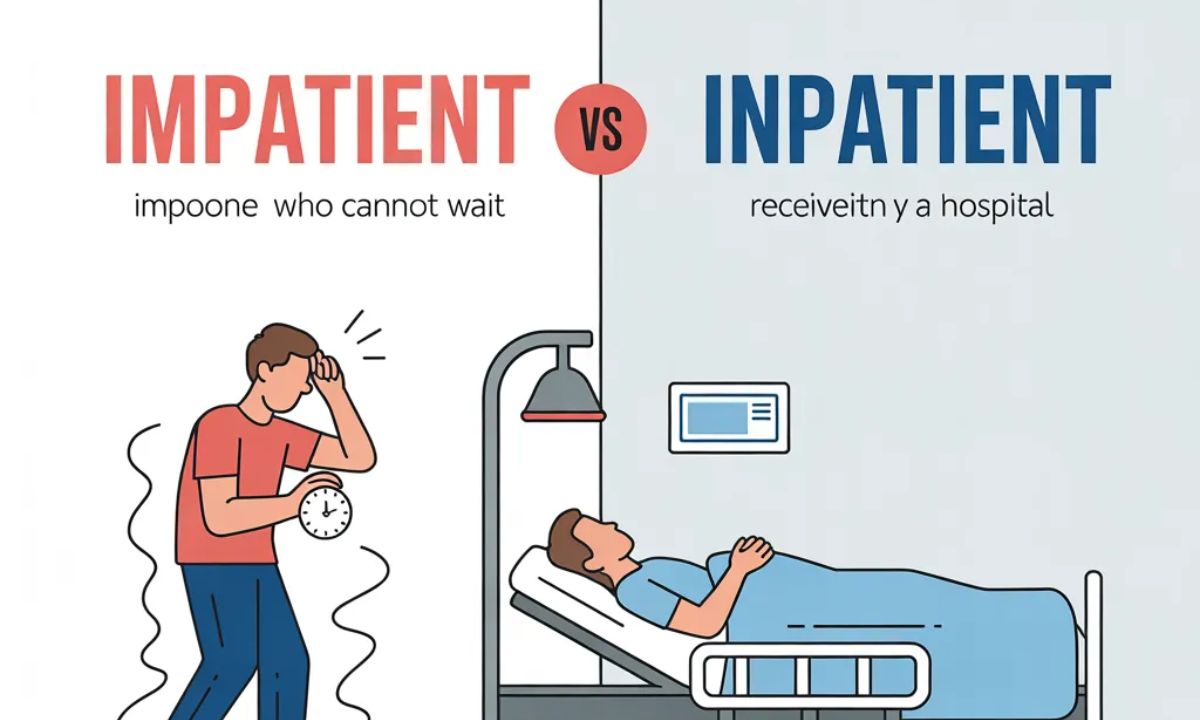
Impatient vs Inpatient is one of the most confusing word pairs in English, and many people search for it to avoid making mistakes in writing or speech. At first glance, both words look similar, but their meanings are completely different. This confusion often happens in school writing, medical contexts, and even social media discussions.
Many users want to know: Is it about mood or hospitals? The answer depends on the spelling. One word describes behavior, while the other relates to healthcare settings.
In this guide, we will clearly break down Impatient vs Inpatient, explain their meanings, show real examples, and help you never confuse them again. Whether you are a student, writer, or English learner, this simple explanation will make everything clear in seconds.
DEFINE Impatient vs Inpatient?
To understand Impatient vs Inpatient, you must first look at both words separately.
Impatient Meaning
“Impatient” describes a person who gets annoyed or frustrated when waiting or when things are slow.
- It is an emotion or behavior.
- It is commonly used in daily conversation.
Example:
- She is impatient while waiting for results.
- He becomes impatient in long queues.
👉 Simple meaning: Not willing to wait calmly
Inpatient Meaning
“Inpatient” is a medical term used for a person who is admitted to a hospital and stays there for treatment.
- It is used in healthcare settings.
- It refers to hospital care that requires overnight stay.
Example:
- The patient was admitted as an inpatient for surgery.
- Inpatient treatment is required for serious illness.
👉 Simple meaning: A hospital patient who stays overnight
Key Difference (Snippet Answer)
- Impatient = emotional behavior (not patient)
- Inpatient = hospital patient staying in care
Quick Overview: Impatient vs Inpatient
The confusion between impatient vs inpatient comes from their similar spelling, but their meanings are completely different. Impatient is a behavior-related word used in everyday life, while inpatient is a medical term used in hospitals. One describes personality, and the other describes a patient’s treatment type.
Understanding the difference is important for correct English usage, especially in writing, healthcare communication, and exams.
What Does “Impatient” Mean? (Definition, Usage & Examples)
Definition and Pronunciation
Impatient means being unable or unwilling to wait calmly. It describes a feeling of frustration when things take too long or do not happen quickly.
Pronunciation: im-PAY-shuhnt
It is an adjective used to express emotional behavior in daily life.
When to Use “Impatient” in Sentences
You use impatient when describing a person’s mood, reaction, or attitude toward waiting or delay.
It is commonly used in everyday communication, emotions, and social situations.
Examples:
- She becomes impatient when the internet is slow.
- He is impatient to receive his exam results.
- Don’t be impatient; good things take time.
👉 In short: use impatient when talking about feelings or behavior.
What Does “Inpatient” Mean? (Medical Definition & Context)
Definition and Pronunciation
Inpatient refers to a patient who is admitted to a hospital and stays there for treatment and care.
Pronunciation: IN-pay-shuhnt
It is a noun used mainly in healthcare and medical documentation.
When to Use “Inpatient” in Medical Context
You use inpatient when referring to hospital care that requires admission and overnight stay.
It is commonly used by doctors, nurses, and hospital systems.
Examples:
- The patient was admitted as an inpatient after surgery.
- Inpatient care is required for serious illnesses.
- He spent three days in the inpatient ward.
👉 In short: use inpatient when talking about hospital treatment.
Inpatient vs. Outpatient
To understand inpatient vs outpatient, here is a simple breakdown:
- Inpatient: A patient who stays in the hospital overnight or longer.
- Outpatient: A patient who visits the hospital for treatment and leaves the same day.
Example:
- Inpatient: Surgery requiring hospital stay
- Outpatient: Routine check-up or minor treatment
👉 This distinction is important in medical billing and healthcare systems.
Side-by-Side Comparison
| Feature | Impatient | Inpatient |
| Meaning | Unable to wait calmly | Hospital-admitted patient |
| Word Type | Adjective | Noun |
| Field | Everyday English | Medical terminology |
| Usage | Emotions & behavior | Healthcare system |
| Example | “I am impatient.” | “He is an inpatient.” |
Examples of Impatient vs. Inpatient in Sentences
Impatient Examples:
- I get impatient when people are late.
- She is impatient to start her new job.
- Children often become impatient while waiting.
Inpatient Examples:
- The hospital has a separate inpatient ward.
- He was treated as an inpatient for two days.
- Inpatient care is more expensive than outpatient care.
Why Impatient vs Inpatient Is Important in 2026
Understanding Impatient vs Inpatient is more important in 2026 because digital communication has increased spelling mistakes and misunderstandings.
Today, people use autocorrect, AI writing tools, and voice typing, which sometimes confuse similar-sounding words. As a result, errors like “I am inpatient” instead of “I am impatient” are common in chats and social media.
In professional fields like healthcare, writing the wrong word can completely change meaning. For example, “inpatient care” is a medical term, while “impatient care” makes no sense.
In education and SEO writing, correct usage also improves clarity, ranking, and credibility. Search engines now prioritize content that is accurate, human-friendly, and contextually correct.
So, learning Impatient vs Inpatient is not just grammar—it is communication accuracy in modern digital life.
How Impatient vs Inpatient Is Used (Real-Life Uses)
Understanding usage helps avoid mistakes in real communication.
1. Social Media Usage
On platforms like Instagram, TikTok, and X (Twitter), people often use “impatient” to express emotions.
- “I’m so impatient for the weekend!”
- “Don’t be impatient, good things take time.”
However, incorrect usage like “I’m inpatient for results” is a common mistake.
2. Medical Usage
“Inpatient” is strictly used in hospitals and healthcare systems.
- Inpatient care
- Inpatient treatment
- Inpatient department (IPD)
Doctors, nurses, and medical staff use this term professionally.
3. AI and Digital Writing Impact
AI tools and grammar checkers now highlight confusion between Impatient vs Inpatient. This helps writers avoid mistakes in blogs, emails, and reports.
Search engines also reward content that uses correct terminology, improving SEO rankings.
4. Education and Exams
Students often confuse these words in essays and grammar tests. Teachers focus on this distinction because it shows understanding of context.
FAQ’s (People Also Ask)
What is the main difference between impatient and inpatient?
The main difference is meaning. Impatient describes a person who cannot wait calmly, while inpatient refers to a hospital patient who stays overnight for medical treatment.
Can someone be both impatient and an inpatient at the same time?
Yes. A person can feel impatient emotionally while also being an inpatient in a hospital. The two words describe different things: emotion vs medical status.
Is “impatient” ever used in medical contexts?
Not usually. “Impatient” is not a medical term. However, doctors may describe a patient as impatient if they are restless or anxious while waiting for treatment.
What’s the opposite of impatient?
The opposite of impatient is patient. A patient person can wait calmly without frustration or stress, even in difficult situations.
What is Impatient vs Inpatient?
Impatient vs Inpatient refers to two commonly confused English words. “Impatient” means not willing to wait calmly, while “inpatient” refers to a hospital patient who stays overnight for treatment or medical care.
What is the difference between impatient and inpatient?
The difference is simple. “Impatient” describes a personality trait related to frustration or lack of patience. “Inpatient” is a medical term used for someone admitted to a hospital for continuous care and observation.
Is inpatient a medical term?
Yes, inpatient is a medical term. It refers to a patient who is admitted to a hospital and stays there for treatment, surgery, or recovery under medical supervision for more than a few hours.
Can we use impatient in hospital terms?
No, “impatient” should not be used in hospital contexts. It describes behavior, not medical care. The correct term in hospitals is “inpatient,” which refers to admitted patients receiving treatment.
Why do people confuse impatient vs inpatient?
People confuse these words because they sound similar and differ only by one letter. However, their meanings are completely different—one is emotional, and the other is medical terminology.
Is inpatient or outpatient the same?
No. An inpatient stays in the hospital overnight or longer. An outpatient visits the hospital for treatment and leaves the same day without admission.
How can I remember impatient vs inpatient easily?
Remember: “Impatient” has “im” like “I’m annoyed.” “Inpatient” has “in” like “inside hospital.” This simple trick helps avoid confusion in writing and speaking.
Conclusion
The confusion between Impatient vs Inpatient is very common, but the difference becomes clear once you understand their meanings. “Impatient” is an emotional word describing someone who cannot wait calmly, while “inpatient” is a medical term used for hospital-admitted patients.
In daily communication, using the correct word improves clarity and prevents misunderstandings. In professional writing, especially in healthcare and education, accuracy is even more important.
As language continues to evolve in 2026 with AI tools and digital communication, mastering simple distinctions like Impatient vs Inpatient helps you write smarter, clearer, and more confidently.
Understanding these differences not only improves grammar but also strengthens communication skills for the future.