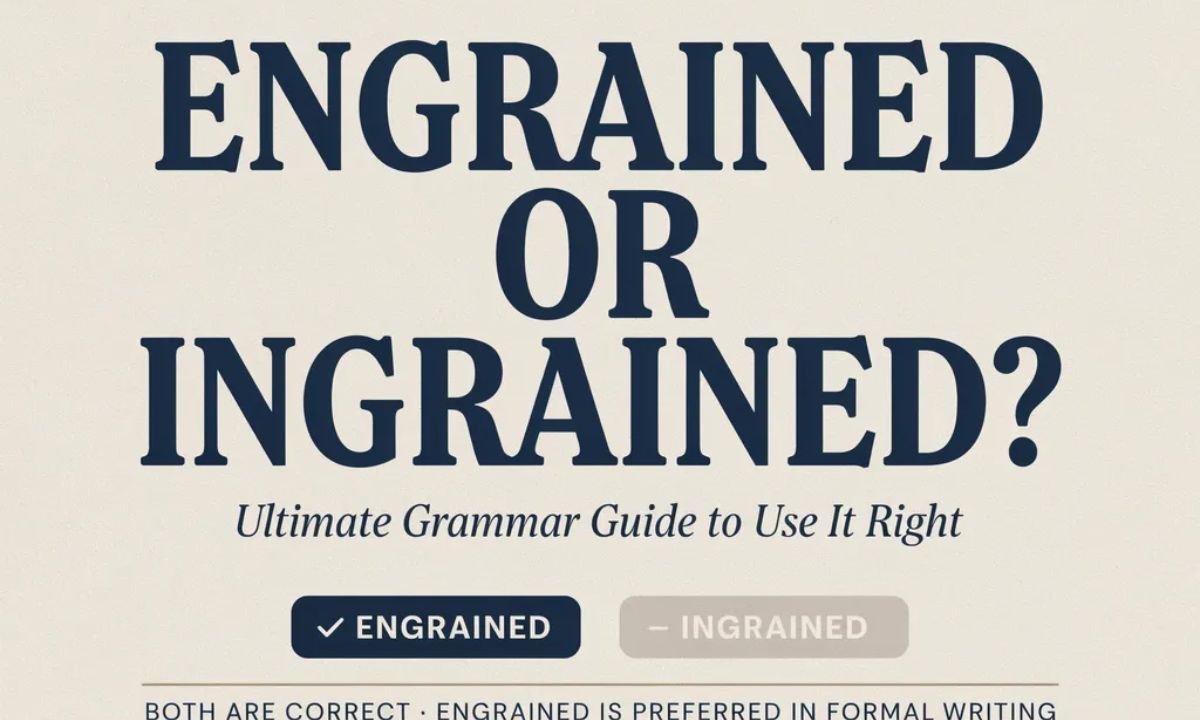
Have you ever stopped while writing and wondered whether engrained or ingrained is the correct word? You’re not alone. Many English speakers confuse these two terms because they sound similar and share a related history. However, their meanings and modern usage are not exactly the same.
In today’s English, ingrained is the preferred and widely accepted form when describing habits, beliefs, attitudes, or behaviors that have become deeply established. Meanwhile, engrained exists as a historical variant, but it appears far less often in modern writing.
In this guide, you’ll learn the difference between engrained or ingrained, discover their origins, see real-world examples, and understand which word you should use in professional and everyday communication.
Why “Ingrained” and “Engrained” Get Mixed Up
The confusion between these words happens for several reasons.
First, both words sound almost identical when spoken. As a result, many writers assume they are interchangeable.
Second, both terms come from related historical roots connected to dyeing cloth. Because of this shared background, dictionaries often mention one word when defining the other.
Finally, spell-checkers may not always flag engrained as incorrect because it is technically a recognized variant. This situation leads many people to believe that both forms are equally common today, even though they are not.
The Core Difference at a Glance
The easiest way to understand the distinction is this:
- Ingrained = The modern and preferred form.
- Engrained = An older and less common variant.
When discussing deeply rooted habits, beliefs, traditions, or behaviors, most style guides and dictionaries recommend using ingrained.
Quick Comparison
| Word | Modern Usage | Commonness |
| Ingrained | Preferred | Very Common |
| Engrained | Historical Variant | Rare |
For most writers, choosing ingrained is the safest option.
Why People Mix Up “Ingrained” and “Engrained”
Several factors contribute to the confusion.
Similar Pronunciation
Most speakers pronounce both words almost the same way. Therefore, people often spell the word based on sound rather than usage.
Shared Origins
Both words developed from old terms associated with dyeing fabrics. Consequently, they maintained similar meanings over time.
Exposure to Older Texts
Readers sometimes encounter engrained in older books, articles, or historical documents. This exposure can make the variant seem more common than it actually is.
Autocorrect Limitations
Since engrained is a legitimate word, grammar tools may not always suggest changing it.
What “Ingrained” Really Means
The adjective ingrained describes something that has become deeply fixed and difficult to change.
It often refers to:
- Habits
- Beliefs
- Attitudes
- Customs
- Behaviors
- Traditions
When something is ingrained, it becomes part of a person’s character or a group’s culture.
Examples
- Honesty is an ingrained value in their family.
- Good study habits become ingrained over time.
- The company has an ingrained culture of teamwork.
- Respect for elders remains ingrained in many societies.
In each example, the idea is deeply rooted and not easily altered.
Everyday Uses of “Ingrained”
You will frequently encounter ingrained in daily communication.
Personal Habits
- Waking up early became an ingrained routine.
Workplace Culture
- Customer service excellence is ingrained in the company’s mission.
Social Traditions
- The festival remains ingrained in local culture.
Education
- Critical thinking should become ingrained during school years.
Because the word applies to so many situations, it remains extremely common in modern English.
The Variant Form: Understanding “Engrained”
The word engrained is not entirely incorrect. Instead, it represents an older spelling and variant form.
Historically, it referred to something dyed with permanent color or something firmly embedded.
Over time, however, ingrained became the dominant spelling. As a result, most modern dictionaries and style guides favor ingrained for nearly all situations.
Today, seeing engrained in contemporary writing is relatively uncommon.
Historical Roots: From Dyeing Cloth to Deeply Held Beliefs
The story behind these words is fascinating.
Centuries ago, cloth manufacturers used special dyes that penetrated deeply into fabric fibers. The color became difficult to remove because it was thoroughly worked into the material.
Eventually, people began using this concept metaphorically.
Just as dye became permanently fixed in cloth, ideas and behaviors could become permanently fixed in people’s minds.
This metaphorical meaning evolved into the modern use of ingrained, describing beliefs and habits that are deeply established.
Verbs Behind the Adjectives: “Ingrain” vs. “Engrain”
Both adjectives originate from related verbs.
Ingrain
Ingrain means to establish something firmly.
Examples:
- Parents try to ingrain good manners in children.
- Teachers ingrain discipline through consistent practice.
Engrain
Engrain exists as a variant verb but appears far less frequently.
Examples:
- Older texts may use engraine or engrain.
- Modern writers generally prefer ingrain.
Therefore, ingrain remains the recommended choice for contemporary writing.
Which Word Wins Today: Usage Data and Linguistic Trends
Modern English strongly favors ingrained.
Writers, journalists, educators, and publishers overwhelmingly use ingrained in books, websites, newspapers, and academic papers.
Meanwhile, engrained appears mainly in:
- Historical documents
- Older literature
- Specialized linguistic discussions
- Occasional regional usage
As language evolves, one form often becomes dominant. In this case, ingrained clearly won that competition.
Real-World Examples of “Ingrained” in Action
Here are practical examples showing how native speakers use the word.
- Teamwork is ingrained in the organization’s culture.
- Healthy habits become ingrained through repetition.
- Respect for the law should be ingrained from childhood.
- The tradition remains ingrained in the community.
- Years of practice ingrained the skill in his mind.
- Environmental awareness has become ingrained in modern society.
These examples demonstrate the word’s flexibility across many contexts.
Frequent Mistakes and How to Avoid Them
Many writers make predictable mistakes when choosing between these terms.
Mistake 1: Assuming Both Are Equally Common
Although both exist, ingrained is far more common today.
Mistake 2: Using Engrained in Formal Writing
Professional documents typically favor ingrained.
Mistake 3: Spelling Based on Pronunciation
Because the words sound similar, writers often choose the wrong spelling.
Mistake 4: Ignoring Context
Historical discussions may occasionally justify engrained, but modern contexts usually require ingrained.
Common Confusions
Many people also confuse these words with similar expressions.
| Incorrect Assumption | Reality |
| Engrained is the modern spelling | Ingrained is the preferred modern spelling |
| Both are used equally often | Ingrained dominates current usage |
| Engrained is always wrong | It is a recognized but uncommon variant |
| Dictionaries reject engrained | Most dictionaries acknowledge it as a variant |
Understanding these distinctions helps improve writing accuracy.
Style and Grammar Tips
Follow these simple guidelines whenever you write.
- Use ingrained in essays, articles, emails, and reports.
- Choose ingrained when discussing habits or beliefs.
- Reserve engrained for historical references if necessary.
- Maintain consistency throughout your document.
- When unsure, select ingrained.
Professional editors almost always prefer ingrained.
When “Engrained” Might Still Work
Although uncommon, engrained may still appear in certain situations.
For example:
- Historical texts
- Quotations from older sources
- Discussions about language history
- Specialized references to traditional dyeing processes
Even in these contexts, many modern editors still favor ingrained unless historical authenticity matters.
Therefore, if your goal is clear and professional communication, ingrained remains the best choice.
Conclusion
Understanding the difference between engrained or ingrained can make your writing more accurate and professional. While both words share historical roots, ingrained has become the standard choice in modern English. It is widely used to describe habits, beliefs, values, and behaviors that are deeply established and difficult to change.
On the other hand, engrained survives mainly as an older variant and appears far less frequently in contemporary writing. Therefore, if you’re writing an essay, article, email, or business document, choosing ingrained is usually the safest option. By learning this distinction, you can avoid common grammar mistakes and communicate your ideas with greater confidence.
FAQs
Is “engrained” a real word?
Yes, engrained is a real word and has historical usage. However, it is considered a less common variant of ingrained and rarely appears in modern writing.
Which is correct: engrained or ingrained?
In most situations, ingrained is the correct and preferred spelling. It is the form recommended by dictionaries, editors, and style guides.
What does “ingrained” mean?
Ingrained means firmly established or deeply rooted. It often describes habits, beliefs, traditions, attitudes, or behaviors that have become a permanent part of someone’s character or culture.
Can I use “engrained” in professional writing?
You can, but it is generally not recommended. Most professional writers and editors prefer ingrained because it is the standard modern spelling.
Why do people confuse engrained and ingrained?
People often confuse them because they sound very similar and share the same historical background. Additionally, some older books and texts still use engrained, which adds to the confusion.
Is “ingrained habit” the correct phrase?
Yes. Ingrained habit is a common and correct expression used to describe a habit that has become deeply established over time.
Is “engrained” considered wrong?
Not exactly. It is not technically wrong because dictionaries recognize it as a variant spelling. However, it is much less common than ingrained and may look outdated to modern readers.
Should I always use “ingrained” instead of “engrained”?
For modern English, the answer is usually yes. Unless you are discussing historical language or quoting an older source, ingrained is the better choice.