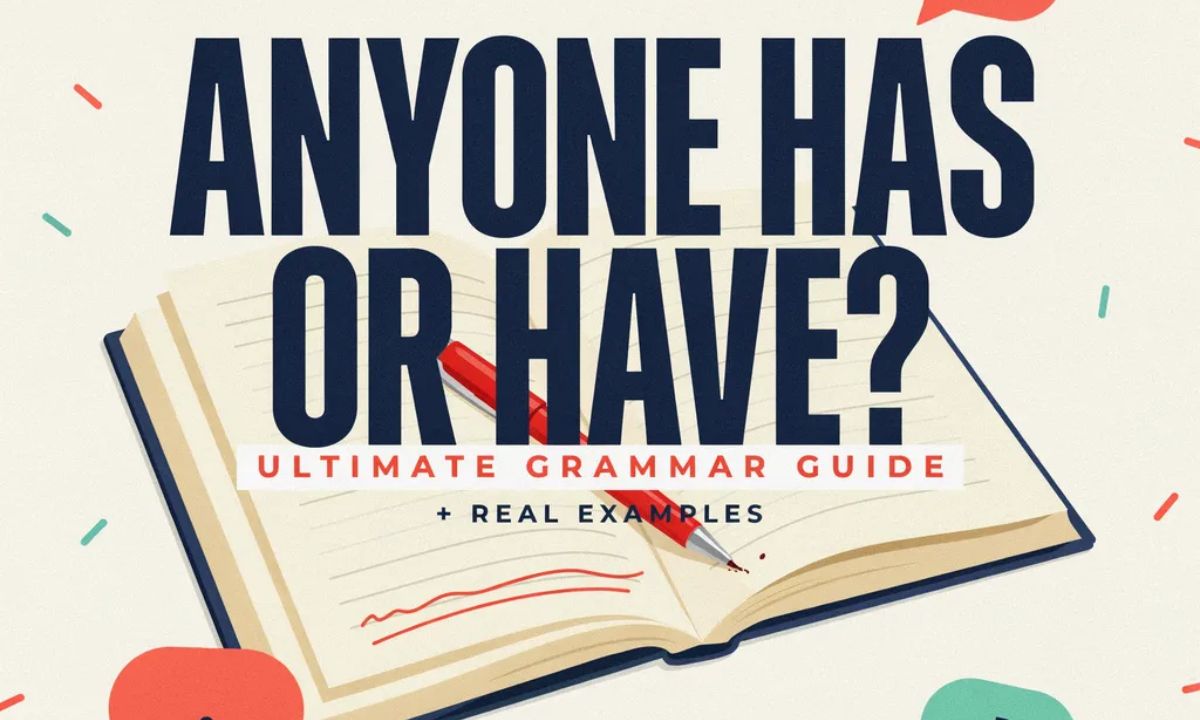
Have you ever stopped while writing and wondered whether “anyone has or have an idea” is correct? You are not alone. Many English learners and even native speakers get confused when using indefinite pronouns like anyone. Although the difference seems small, choosing the correct verb form can make your writing sound more natural and grammatically correct.
In this guide, you’ll learn the rules behind anyone has or have an idea, understand why one form is usually correct, and discover how context can sometimes influence the choice. Moreover, you’ll find practical examples, common mistakes, and simple explanations that make this grammar topic easy to master.
Understanding the Basics: ‘Anyone Has’ vs. ‘Anyone Have’
The confusion between “anyone has” and “anyone have” comes from the word anyone. At first glance, anyone may seem like it refers to many people. However, grammatically, it is considered a singular indefinite pronoun.
Because anyone is singular, it generally takes a singular verb.
Correct:
- Anyone has an idea about the project.
- Anyone who has questions can contact me.
Incorrect:
- Anyone have an idea about the project.
However, there are situations where “anyone have” appears naturally, especially in questions and hypothetical statements. Therefore, understanding the context is essential.
Grammatical Rules: When to Use ‘Anyone Has’
Declarative Sentences
A declarative sentence simply states information. In these cases, anyone usually requires the singular verb has.
Examples:
- Anyone has the right to express their opinion.
- Anyone who has experience in marketing can apply.
- If anyone has concerns, please let us know.
These sentences make statements, so the singular verb form is appropriate.
Formal Contexts
In formal writing, subject-verb agreement rules are followed strictly. Therefore, “anyone has” is often preferred when making statements.
Examples:
- If anyone has additional information, submit it before Friday.
- Anyone who has completed the training may participate.
- Anyone who has access to the system must follow security guidelines.
Formal documents, academic writing, and business communications commonly use this structure.
Conditional Clauses
Conditional clauses often begin with words such as if.
Examples:
- If anyone has an idea, we would love to hear it.
- If anyone has questions, please ask now.
- If anyone has concerns regarding the policy, contact management.
In these situations, has remains correct because anyone is still singular.
Exploring the Use of ‘Anyone Have’
Questions / Interrogatives
When asking questions, native speakers often use “Does anyone have” rather than “Anyone has.”
Examples:
- Does anyone have an idea?
- Does anyone have a pen?
- Does anyone have experience with this software?
In casual speech, people sometimes shorten the phrase and say:
- Anyone have an idea?
- Anyone have a charger?
Although this is common in conversation, it is technically an abbreviated form of “Does anyone have.”
Subjunctive Mood and Hypothetical Situations
The subjunctive mood expresses wishes, possibilities, or hypothetical situations.
Examples:
- I suggest that anyone have access to the materials.
- It is important that anyone have equal opportunities.
These structures are less common but grammatically acceptable in specific formal contexts.
Everyday Use
In everyday conversation, people frequently drop helping verbs.
Examples:
- Anyone have a phone charger?
- Anyone have any suggestions?
- Anyone have time for a quick meeting?
While these expressions are common in speech, they are generally avoided in formal writing.
Subject-Verb Agreement and Indefinite Pronouns
Subject-verb agreement means that subjects and verbs must match in number.
Since anyone is singular, it takes singular verbs.
Examples:
- Anyone has
- Anyone is
- Anyone knows
- Anyone wants
Remember this simple rule:
Singular subject = Singular verb
This rule helps prevent many common grammar mistakes.
Common Indefinite Pronouns
The following indefinite pronouns are also singular:
- Anyone
- Anybody
- Everyone
- Everybody
- Someone
- Somebody
- No one
- Nobody
- Each
- Either
- Neither
Examples:
- Everyone has a responsibility.
- Somebody has left their bag.
- Nobody knows the answer.
All of these pronouns typically require singular verbs.
Common Mistakes and Exceptions
Many learners make mistakes because they focus on meaning rather than grammar.
Common mistakes include:
❌ Anyone have an answer.
✅ Does anyone have an answer?
❌ Anyone know the solution.
✅ Does anyone know the solution?
❌ Anyone have experience with this.
✅ Does anyone have experience with this?
An exception occurs in casual speech where shortened expressions are widely accepted. Nevertheless, formal writing should follow standard grammar rules.
Incremental Nuances in English Grammar
English grammar often changes depending on context, tone, and audience.
Spoken vs. Written English
Spoken English is generally more flexible.
Conversation:
- Anyone have an extra notebook?
Formal Writing:
- Does anyone have an extra notebook?
Speech often prioritizes speed and convenience, while writing emphasizes correctness.
Regional Variations
Different English-speaking regions sometimes use slightly different sentence structures.
For example, informal American, British, Australian, and Canadian English speakers may all say:
- Anyone have a minute?
However, grammar books still recommend:
- Does anyone have a minute?
Formal standards remain largely consistent across regions.
Context Matters
The surrounding context often determines which structure sounds natural.
For example:
Formal Meeting:
- Does anyone have any questions?
Text Message:
- Anyone have ideas for dinner?
Both sentences work well because they match their contexts.
Practical Examples in Everyday Language
Here are some common situations where the phrase appears naturally.
At Work:
- Does anyone have updates on the project?
In Class:
- Does anyone have the answer to question five?
Among Friends:
- Anyone have plans for the weekend?
Online Discussion:
- Does anyone have experience using this app?
During a Meeting:
- If anyone has suggestions, please share them.
These examples demonstrate how context influences sentence structure.
Clarifying Confusions with Pronunciation and Flow
Many people choose “anyone have” because it sounds smoother in fast conversation.
Compare:
- Does anyone have an idea?
- Anyone have an idea?
The second version feels quicker and more conversational. However, the first version is grammatically complete and suitable for professional communication.
When writing formally, always prioritize grammar over conversational shortcuts.
Additional Insights: ‘Anybody Have’ vs. ‘Anybody Has’
The same rules apply to anybody.
Formal Examples:
- Does anybody have a question?
- If anybody has concerns, contact us.
Informal Examples:
- Anybody have a charger?
- Anybody have suggestions?
Just like anyone, anybody is grammatically singular. Therefore, statements generally use has, while questions typically use does anybody have.
In most situations, the safest and most grammatically correct choice is to use “anyone has” in statements and “does anyone have” in questions. Understanding this distinction will help you write with greater confidence and communicate more clearly in both formal and informal English.
Conclusion
Understanding the difference between “anyone has” and “anyone have” can significantly improve your English grammar skills. In most cases, “anyone has” is the correct choice because anyone is a singular indefinite pronoun that requires a singular verb. However, you may hear “anyone have” in casual conversations, especially as a shortened form of questions like “Does anyone have?”
Moreover, context plays an important role. Formal writing typically follows strict subject-verb agreement rules, while spoken English often allows more flexibility. By learning these grammar patterns and practicing them regularly, you can communicate more clearly and confidently in both professional and everyday situations.
FAQs
Is “Anyone Has an Idea” grammatically correct?
Yes, “Anyone has an idea” can be grammatically correct in certain statements. However, native speakers more commonly say “Does anyone have an idea?” when asking a question.
Should I use “Anyone Has” or “Anyone Have”?
Use “anyone has” in statements because anyone is singular. Use “does anyone have” when forming a question.
Why is “Anyone” considered singular?
Although anyone can refer to any person, grammar rules classify it as a singular indefinite pronoun. Therefore, it usually takes singular verbs such as has, is, and knows.
Is “Anyone Have an Idea?” wrong?
Not necessarily. It is common in informal speech and casual writing. However, the complete and grammatically standard form is “Does anyone have an idea?”
Can I use “Anyone Have” in professional writing?
It is better to avoid it. In professional, academic, or business writing, use “Does anyone have” or “Anyone has” depending on the sentence structure.
What is the difference between “Anyone Has” and “Anybody Has”?
There is virtually no difference in meaning. Both anyone and anybody are singular indefinite pronouns and follow the same grammar rules.
Is “If Anyone Has Questions” correct?
Yes. This is a very common and grammatically correct expression. For example: “If anyone has questions, please contact us.”
What are other singular indefinite pronouns like “Anyone”?
Other common singular indefinite pronouns include everyone, everybody, someone, somebody, no one, nobody, each, either, and neither. These pronouns typically require singular verbs.
Why do native speakers often say “Anyone Have”?
Native speakers frequently shorten sentences in casual conversation. As a result, “Anyone have?” is often used as a quick version of “Does anyone have?”
How can I remember the correct rule?
A simple trick is to remember that anyone = one person grammatically. Since it is singular, use singular verbs such as has, is, and knows in standard English.