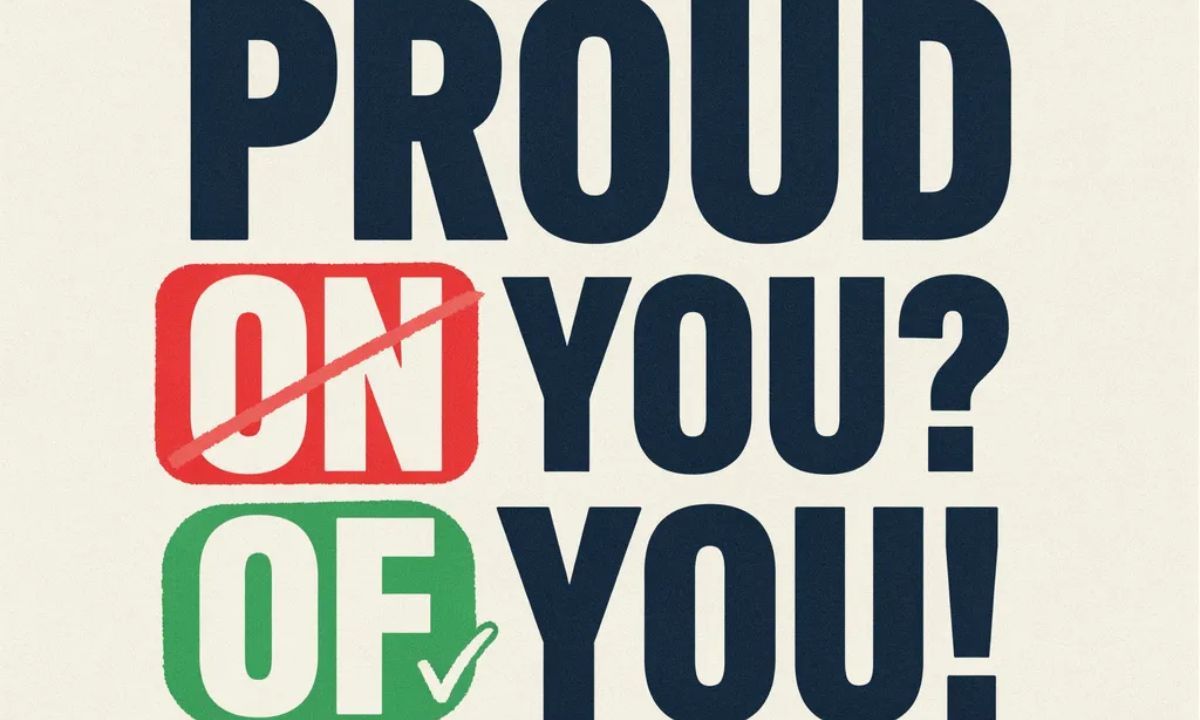
Have you ever stopped and wondered whether you should say “proud for you” or “proud of you”? Many English learners and even native speakers get confused by these expressions. In fact, people often search for “proud on you or of you” because they are unsure which preposition sounds natural and grammatically correct.
Fortunately, the answer is simple. Although both phrases may appear similar, they do not carry the same meaning. Moreover, one expression is widely accepted in standard English, while the other is only appropriate in limited situations. Therefore, understanding the difference can help you communicate more clearly and confidently.
In this complete guide, you’ll learn the meaning of “proud,” discover when to use each phrase, explore common mistakes, and see practical examples from everyday conversations.
Understanding the Core Meaning of “Proud”
The adjective “proud” describes a feeling of satisfaction, admiration, or pleasure about someone’s achievements, qualities, or actions.
People often feel proud when:
- A child graduates from school.
- A friend reaches an important goal.
- A team wins a competition.
- Someone overcomes a difficult challenge.
For example:
- “I’m proud of my daughter for earning her degree.”
- “We’re proud of our team’s hard work.”
In these examples, pride comes from admiration for what someone has accomplished.
The Grammar Behind “Proud of You”
In English grammar, the adjective “proud” is traditionally followed by the preposition “of.” This structure has been used for centuries and remains the standard form today.
The correct pattern is:
Proud + of + person/achievement
Examples:
- “I’m proud of you.”
- “She is proud of her son.”
- “We are proud of our accomplishments.”
Because of this grammatical rule, native speakers naturally use “proud of you” when expressing admiration toward someone.
✅ When to Use “Proud of You”
Use “proud of you” whenever you want to praise someone’s effort, success, growth, or character.
Examples:
- “I’m proud of you for finishing the project.”
- “Your parents must be proud of you.”
- “We’re proud of you for never giving up.”
- “I’m proud of you for being honest.”
This phrase feels warm, supportive, and encouraging. As a result, it is commonly used by parents, teachers, coaches, friends, and colleagues.
Why “Proud for You” Sounds Awkward
Unlike “proud of you,” the phrase “proud for you” is not commonly used in everyday English.
The reason is simple. Pride usually belongs to the person feeling admiration. Therefore, saying you’re “proud of someone” makes grammatical and logical sense.
On the other hand, “proud for you” suggests that you are experiencing pride on someone else’s behalf. Since pride is generally a personal emotion, this wording often sounds unnatural.
For example:
❌ “I’m proud for you.”
Most native speakers would instead say:
✅ “I’m proud of you.”
⚠️ When “Proud for You” Can Work
Although uncommon, “proud for you” may occasionally appear in special contexts.
For example:
- “I am proud for you because you finally achieved your dream.”
- “We are proud for the entire community.”
Even in these cases, many native speakers would still prefer:
- “I’m proud of you.”
- “I’m happy for you.”
As a result, “proud for you” remains relatively rare.
Comparison Table
| Phrase | Correct? | Meaning | Common Usage |
| Proud of you | ✅ Yes | Admiration for someone’s achievement | Very common |
| Proud for you | ⚠️ Sometimes | Feeling pride on someone’s behalf | Rare |
| Proud on you | ❌ No | Grammatically incorrect | Never used |
Common Mistakes and How to Fix Them
Many English learners make small errors when using expressions related to pride. Fortunately, these mistakes are easy to correct.
❌ Mistake #1: Mixing “of” and “for” Interchangeably
Wrong:
- “I’m proud for you.”
- “She is proud for her son.”
Correct:
- “I’m proud of you.”
- “She is proud of her son.”
Remember that “of” is the standard preposition after “proud.”
❌ Mistake #2: Using “Proud for You” as a Direct Compliment
Many people mistakenly use “proud for you” when congratulating someone.
Wrong:
- “I’m proud for you on your promotion.”
Better:
- “I’m proud of you for your promotion.”
- “I’m happy for you.”
These alternatives sound much more natural.
✅ Simple Trick to Remember
Ask yourself:
“Who owns the achievement?”
If you’re admiring someone, use:
✅ Proud of you
If you’re sharing happiness about their success, use:
✅ Happy for you
This quick trick helps eliminate confusion instantly.
Historical and Linguistic Background
The word “proud” comes from older forms of English and has long been associated with the preposition “of.”
Over hundreds of years, phrases like:
- Proud of your work
- Proud of your family
- Proud of your country
became deeply rooted in English usage.
As language evolved, this pattern remained consistent. Consequently, modern English still strongly favors “proud of.”
Emotional and Social Impact of Saying “Proud of You”
The phrase “proud of you” carries significant emotional weight.
People often remember hearing these words from:
- Parents
- Teachers
- Mentors
- Coaches
- Loved ones
Because of this emotional connection, the phrase can boost confidence and strengthen relationships.
💬 Real-Life Example
Imagine a student who struggles for years with mathematics but finally passes an important exam.
A parent says:
“I’m proud of you.”
Those four words can create a lasting sense of accomplishment and motivation.
🧠 Fact:
Psychologists often note that positive recognition helps improve confidence, self-esteem, and motivation. Therefore, sincere praise can have a meaningful impact on personal growth.
Alternative Ways to Express Pride
If you want variety in your speech or writing, consider these alternatives:
- I admire your hard work.
- You should be proud of yourself.
- You’ve done an amazing job.
- Congratulations on your achievement.
- I respect your dedication.
- You’ve come a long way.
- Your effort paid off.
- Well done!
These expressions communicate similar feelings while adding variety.
🎯 Quick Tip:
When speaking professionally, choose phrases like:
- “Excellent work.”
- “Your efforts are impressive.”
- “Congratulations on your success.”
These sound polished and professional.
Quick Recap: The Rule in a Nutshell
Here is the simple rule:
✅ Proud of you = Correct and common
⚠️ Proud for you = Rare and limited
❌ Proud on you = Incorrect
Whenever you want to praise someone, choose “proud of you.”
Case Study: “Proud of You” in Real Life
Consider a workplace scenario.
Sarah spends months leading an important project. After the successful launch, her manager says:
“I’m proud of you and the dedication you’ve shown.”
This statement:
- Recognizes effort
- Builds confidence
- Encourages future success
- Strengthens workplace relationships
As a result, the phrase becomes more than grammar—it becomes a powerful form of encouragement.
Final Thoughts on Using “Pride” Expressions
Understanding the difference between “proud for you” and “proud of you” can make your English sound more natural and professional.
If you are still wondering about “proud on you or of you,” remember that “proud on you” is not correct English. Meanwhile, “proud of you” is the standard and widely accepted expression.
Whenever you want to celebrate someone’s achievement, effort, or growth, confidently say:
“I’m proud of you.”
It’s grammatically correct, emotionally meaningful, and universally understood.
Conclusion
Understanding the difference between “proud for you” and “proud of you” is easier once you know the role of the prepositions. In standard English, “proud of you” is the correct and natural expression when you want to admire someone’s achievements, efforts, or personal growth. Meanwhile, “proud for you” appears only in rare situations and often sounds unnatural to native speakers.
If you’ve been searching for “proud on you or of you,” remember this simple rule: “proud of you” is correct, “proud for you” is uncommon, and “proud on you” is grammatically incorrect. By using the right phrase, you can communicate more clearly and make your English sound more fluent and professional.
FAQs About “Proud of You” vs “Proud for You”
Is “proud on you” grammatically correct?
No. “Proud on you” is not a correct English expression. The adjective proud is normally followed by the preposition of, not on.
Which is more common: “proud of you” or “proud for you”?
“Proud of you” is far more common and widely accepted in both spoken and written English. Native speakers use it regularly to express admiration and support.
Can I say “I am proud for you” in a professional setting?
You can, but it may sound awkward. In professional communication, it is better to say “I am proud of you,” “Congratulations,” or “I’m happy for you.”
Why does “proud of you” sound more natural?
English grammar traditionally pairs the adjective proud with the preposition of. Because native speakers hear and use this combination frequently, it sounds natural and correct.
What is the difference between “proud of you” and “happy for you”?
“Proud of you” shows admiration for someone’s effort, character, or achievement. “Happy for you” expresses joy about someone’s good fortune or success.
Can parents and teachers use “proud of you”?
Absolutely. Parents, teachers, coaches, and mentors often use “proud of you” to encourage and motivate others after an accomplishment.
Is “proud of” always used with people?
No. You can be proud of many things, including achievements, organizations, places, or personal qualities.
Examples:
- I am proud of my work.
- She is proud of her family.
- We are proud of our community.
How do I remember the correct phrase?
Use this simple rule:
- Proud of = admiration
- Happy for = shared happiness
- Proud on = incorrect
This quick reminder will help you choose the correct phrase every time.