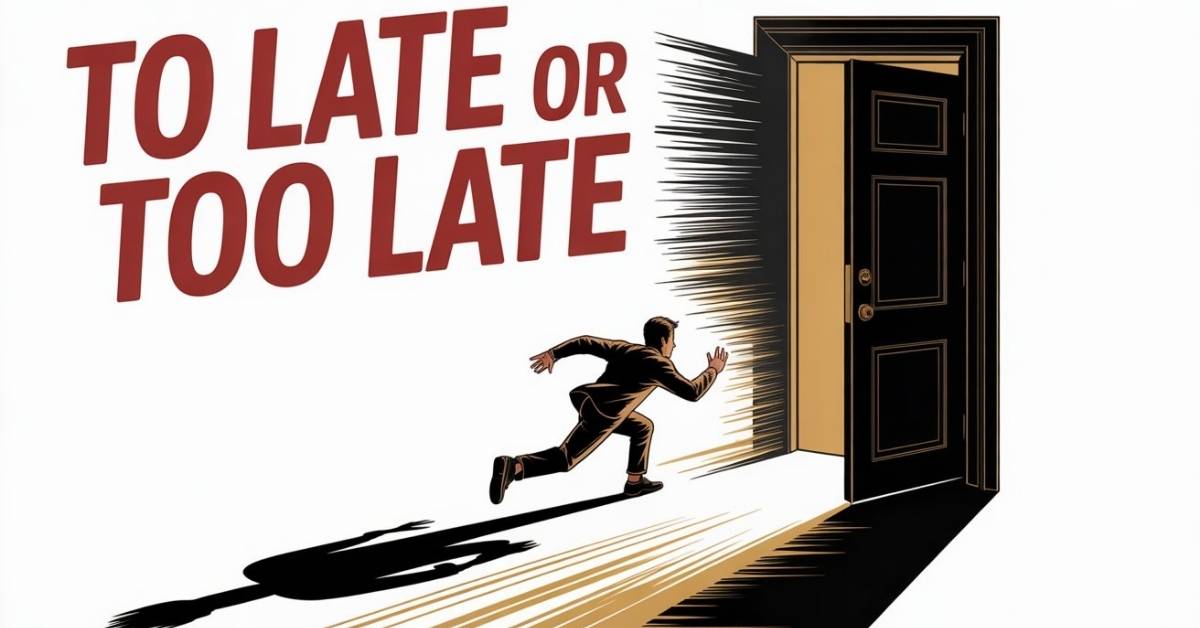
To late or too late—which one is correct? The answer is simple: “too late” is the correct phrase, while “to late” is incorrect in standard English grammar.
If you’ve ever asked to late or too late? or is it to late or too late, you’re dealing with one of the most common word confusion errors in English.
This complete guide explains the difference between “to” and “too,” the correct usage of “too late,” and how to avoid this mistake permanently. By the end, you’ll not only understand the rule but also use it confidently in everyday writing.
To Late or Too Late?
Here’s the direct answer:
- Too late ✅ → Correct phrase
- To late ❌ → Incorrect phrase
👉 So, whenever you wonder is it to late or too late?, always choose “too late.”
Why?
Because “too” is an adverb that means excessively or more than needed, while “to” is a preposition that does not fit in this context.
What Does “Too Late” Mean?
The phrase “too late” describes a situation where time has passed and an action can no longer be done successfully.
Meaning in Simple Terms
- A missed opportunity
- A delayed action
- A point beyond correction
Examples
- It’s too late to change the decision.
- We arrived too late for the meeting.
- By the time he realized, it was already too late.
👉 This phrase is widely used in spoken English, writing, and formal communication.
Why Is “To Late” Incorrect? (Grammar Explanation)
The phrase “to late” is grammatically incorrect because “to” cannot function as an adverb.
Understanding “To”
- “To” is a preposition
- It shows direction or purpose
Example
- Go to school
- Give it to me
👉 You can see that “to” doesn’t express degree or intensity, which is required in the phrase “too late.”
Is It To Late or Too Late Grammar? (Core Rule Explained)
When asking is it to late or too late grammar, the answer depends on parts of speech.
Grammar Breakdown
| Word | Type | Function |
|---|---|---|
| to | Preposition | direction or purpose |
| too | Adverb | degree (excessively, more than needed) |
Key Rule
Use “too” when you mean “excessively” or “beyond a limit.”
👉 That’s why “too late” is correct—it expresses excess time passing.
To vs Too (Comparison Table)
| Word | Meaning | Usage Example |
|---|---|---|
| to | direction/purpose | go to school |
| too | excessively/also | too late |
This table simplifies the difference between to and too, which is essential for writing accuracy.
To Late vs Too Late (Direct Comparison Table)
| Phrase | Correct? | Reason |
|---|---|---|
| too late | ✅ Yes | “too” expresses degree |
| to late | ❌ No | incorrect grammar |
👉 This is a high-value SEO section for quick understanding.
Real-Life Examples of “Too Late” in Sentences
Examples make grammar easier to understand.
Everyday Usage
- It’s too late to call him now.
- I realized the mistake too late.
Professional Writing
- The application was submitted too late.
- The company acted too late to prevent losses.
Emotional Context
- It was too late to fix the relationship.
👉 These examples show how “too late” fits naturally in different contexts.
Common Phrases and Variations (Correct vs Incorrect)
Many users search variations like it is to late or too late or its not to late or too late. Let’s clarify.
It Is To Late or Too Late
Correct: It is too late Incorrect: It is to late
It’s Not To Late or Too Late
Correct: It’s not too late Incorrect: It’s not to late
Is It To Late or Too Late?
Correct: Is it too late?
👉 These variations target real user queries and voice search intent.
To Late or Too Late Lyrics – Why This Confusion Happens
Sometimes, you may see incorrect phrases in songs, social media, or informal writing.
Why?
- Artistic freedom
- Intentional grammar breaking
- Typing mistakes
👉 However, in standard English grammar, only “too late” is correct.
Why Do People Confuse “To” and “Too”?
This confusion is extremely common.
Main Reasons
- Both words sound the same
- Fast typing errors
- Lack of grammar awareness
👉 This is a classic example of homophone confusion in English.
Easy Trick to Remember the Difference
Here’s a simple memory trick:
“Too has an extra ‘o’—it means extra.”
Apply It
- Too late = extra late
- Too much = extra much
👉 This trick helps eliminate spelling mistakes instantly.
Common Grammar Mistakes Related to To vs Too
The confusion doesn’t stop here.
Similar Mistakes
- to vs too
- their vs there vs they’re
- your vs you’re
👉 These are among the most common grammar mistakes in English writing.
Too Late in Professional and Academic Writing
Correct grammar matters in formal settings.
Where It Matters
- Emails
- Reports
- Essays
- Business communication
Example
- Incorrect: The response came to late ❌
- Correct: The response came too late ✔
👉 Proper usage improves credibility and writing clarity.
Advanced Insight: “Too” as an Adverb
Understanding grammar deeply improves SEO content quality.
Role of “Too”
- Acts as an adverb
- Modifies adjectives and verbs
Examples
- too fast
- too expensive
- too late
👉 This adds semantic authority and depth to your content.
LEARN MORE: TYSM Meaning
Case Study: Real Impact of Grammar Mistakes
Imagine sending this message:
“It is to late to fix the issue.”
Impact
- Looks unprofessional
- Reduces trust
- Confuses readers
Correct version:
“It is too late to fix the issue.”
👉 Small corrections make a big difference in communication quality.
Quick Summary: To Late or Too Late
- Too late = correct phrase
- To late = incorrect
- “Too” = adverb (means excessive)
- “To” = preposition (direction/purpose)
Frequently Asked Questions
To late or too late—which is correct?
The correct phrase is too late.
Is it to late or too late grammar correct?
Too late is grammatically correct.
Why is “too late” correct?
Because “too” expresses degree or excess.
Can “to late” ever be correct?
No, it is always incorrect in standard English.
What does “too late” mean?
It means an action cannot be done because time has passed.
Final Thoughts: Mastering To vs Too
Understanding to late or too late is one of the easiest ways to improve your English grammar and writing accuracy. Once you remember that “too” means extra, the confusion disappears.
By applying this simple rule, using examples, and practicing regularly, you’ll avoid this mistake completely. Over time, your writing will become more professional, clear, and Friendly, helping you communicate effectively in any situation.