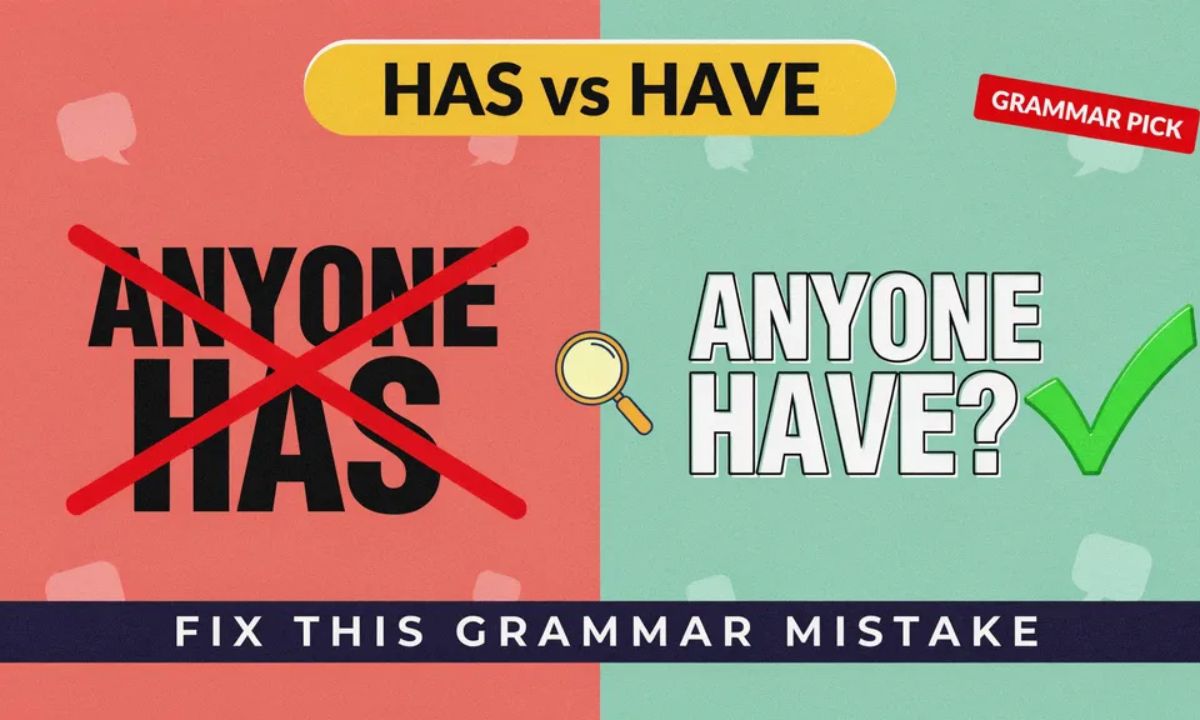
Many English learners get confused about “anyone has” or have examples because both forms may sound correct in casual conversation. However, grammar follows clear rules, and understanding them can help you avoid common mistakes. If you have ever wondered whether to say “anyone has” or “anyone have,” you are not alone. This small grammar point often creates confusion in both writing and speaking.
In this guide, we will explain “anyone has” or have examples in simple English with clear rules and practical sentences. Moreover, you will learn when to use each form, why singular and plural verbs matter, and how to spot the correct usage quickly. By the end, you will understand this grammar topic with confidence and use anyone has or anyone have correctly in everyday English.
Quick Answer First: Anyone Has vs Anyone Have
The quick answer is simple: “anyone has” is usually correct in standard English because anyone is a singular pronoun. For example, you would say, “If anyone has a question, please ask now.” This sentence is correct because has matches the singular subject anyone.
However, some learners get confused because they also hear sentences like “Does anyone have a pen?” In this case, have is correct because it follows the helping verb does. The main verb changes form after helping verbs. So, the correct choice depends on the sentence structure. Understanding this difference makes it easier to use anyone has or anyone have correctly.
The Core Grammar Rule You Must Know
The most important grammar rule is this: the verb must agree with the subject. This is called subject-verb agreement. Since anyone refers to one person, even though it sounds general, it takes a singular verb.
That is why we say “Anyone has the right to speak” in theory, although this sentence sounds unnatural in everyday English. More commonly, we use sentences like “If anyone has information, call us.” On the other hand, after helping verbs such as does, did, can, or will, the base verb is used. For example: “Does anyone have an answer?” Learning this core rule helps you avoid grammar mistakes.
Anyone Is Always Singular
Many people think anyone might be plural because it can refer to many possible people. However, in grammar, anyone is always treated as singular. It means any one person, not a group.
For example: “Anyone who wants to join is welcome.” Here, anyone refers to any single person from a group, so the verb must stay singular. This rule applies in all standard grammar situations. Even if the meaning feels broad, the grammar stays singular.
Common Singular Indefinite Pronouns
Anyone belongs to a group called singular indefinite pronouns. These pronouns refer to people or things in a general but singular way. Because of this, they always take singular verbs.
Some common singular indefinite pronouns include:
- Anyone
- Anybody
- Someone
- Somebody
- Everyone
- Everybody
- No one
- Nobody
- Each
- Either
- Neither
Examples:
- Everyone is ready.
- Somebody has my book.
- Nobody knows the answer.
These pronouns may sound like they refer to many people, but grammar treats them as singular. That is why singular verbs must follow them.
When “Anyone Has” Is Correct
You use “anyone has” when anyone is the subject of the sentence and no helping verb changes the verb form. In this case, the singular verb has agrees with the singular pronoun anyone.
Example sentences:
- If anyone has a problem, tell me now.
- Anyone has the right to ask questions.
- If anyone has extra notes, please share them.
In these examples, has is correct because it matches the singular subject. This is one of the most common situations where learners need to remember the rule.
Declarative Statements
A declarative statement is a sentence that gives information or states a fact. In these sentences, anyone usually takes the singular verb has if it is the subject.
Examples:
- Anyone has the opportunity to apply.
- If anyone has concerns, management will listen.
- Anyone who has experience can join the team.
These sentences simply state information. Since anyone is singular, the verb remains singular too. Declarative statements often follow this pattern in formal grammar.
Embedded Clauses and Indirect Speech
An embedded clause is a smaller clause inside a larger sentence. In these sentences, anyone still follows the singular rule and usually takes has when it is the subject of that clause.
Examples:
- I wonder if anyone has seen my keys.
- She asked whether anyone has an idea.
- We want to know if anyone has experience in design.
Here, anyone has appears inside another sentence, but the grammar rule does not change. Even in indirect speech or embedded clauses, anyone stays singular and takes has.
Formal and Written English
In formal and written English, grammar rules are usually followed more carefully. Because of this, anyone is treated as singular, and writers use verbs that match this rule.
Examples in formal writing:
- If anyone has evidence, they should submit it immediately.
- Anyone who has completed the form may proceed.
- If anyone has additional comments, please contact the office.
Formal English often uses correct subject-verb agreement because it makes writing clear and professional. So, when writing essays, reports, emails, or official documents, remembering the rule for anyone has can help you write better English.
Conclusion
Understanding “anyone has” or have examples becomes easy once you know the basic grammar rule. The word anyone is always a singular indefinite pronoun, so it usually takes a singular verb like has. For example, “If anyone has a question, ask now” is correct because the subject and verb agree. This simple rule helps you avoid one of the most common English grammar mistakes.
However, sentence structure can change the verb form. That is why you may also see have in sentences like “Does anyone have a pen?” In this case, the helping verb changes the main verb to its base form. By learning these rules and practicing with examples, you can confidently use anyone has or anyone have correctly in both speaking and writing.
FAQs
Is it correct to say “anyone has”?
Yes, “anyone has” is correct when anyone is the subject of the sentence and no helping verb changes the verb form. Example: “If anyone has a problem, let me know.”
Is “anyone have” ever correct?
Yes, “anyone have” is correct when it follows a helping verb such as does, did, can, will, or should. Example: “Does anyone have a calculator?”
Why is anyone singular in grammar?
Anyone means any one person, so grammar treats it as singular even though it can refer to many possible people.
Which is correct: “Does anyone has” or “Does anyone have”?
“Does anyone have” is correct. After does, the main verb must stay in its base form, so have is used instead of has.
What type of pronoun is anyone?
Anyone is a singular indefinite pronoun. It refers to an unspecified person in a general way.
Can I use “anyone have” in a statement?
Usually, no. In a normal statement, anyone takes the singular verb has. Example: “If anyone has the answer, please speak.”
What are other singular indefinite pronouns like anyone?
Words like someone, everyone, anybody, nobody, somebody, each, either, and neither are also singular indefinite pronouns and usually take singular verbs.